



| Comparing AA (Absolute Absolute) with Hegel’s Abs |
| 送交者: hare 2025年04月06日08:30:02 于 [教育学术] 发送悄悄话 |
|
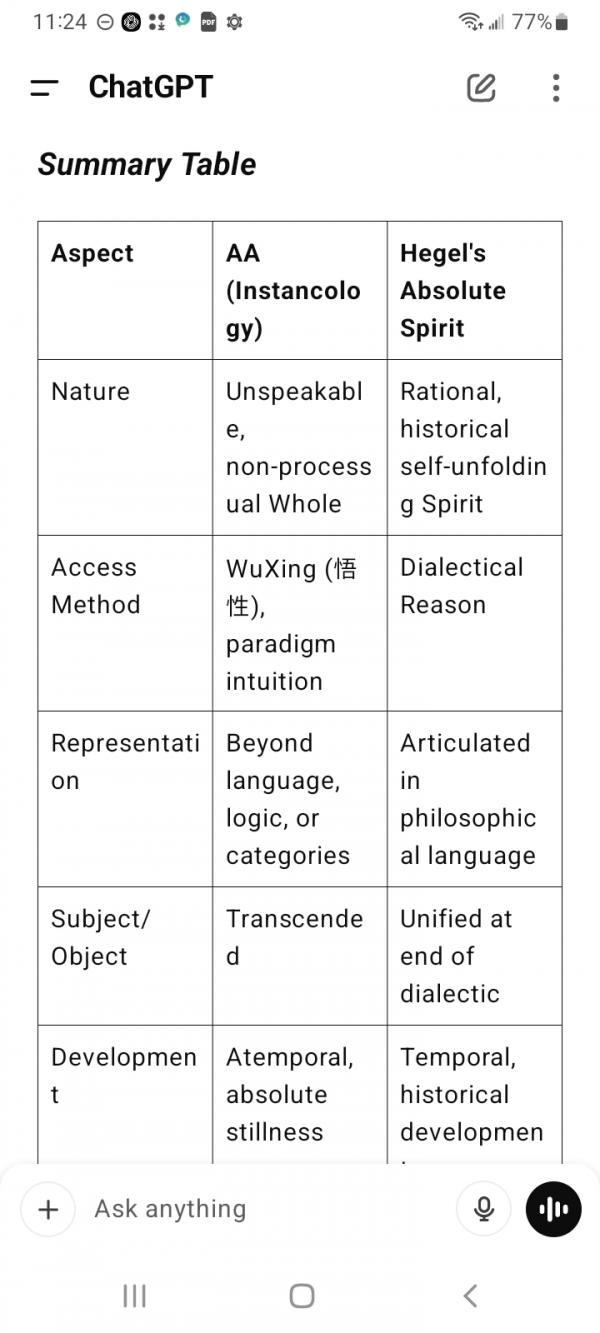
1. Ontological Status AA (Instancology): The Absolute Absolute is the unspeakable, non-representable, non-dualistic Whole. It precedes all logic, being, or categories. It is neither a being nor Being itself, but the background of all instances—natur
al, artificial, or conceptual. It cannot be approached by language or dialectics but only “touched” through 悟性 (WuXing)—a non-rational, non-experiential intuitive grasp. Hegel’s Absolute Spirit: The Absolute Spirit is the culmination of the dialectical process, where Spirit (Geist) comes to know itself through history, art, religion, and finally philosophy. It is still conceptual and developmental, rooted in the self-unfolding of Reason. Hegel’s Absolute is not ineffable, but rationally graspable, albeit at the peak of conceptual labor. --- 2. Epistemology AA (Instancology): Knowledge cannot reach AA through reasoning or experience. It is accessed through a third epistemology: WuXing (悟性), beyond Kant’s sensibility and understanding. This mode is akin to a sudden Aha!—a paradigmatic intuition that transcends all instances, including language, categories, and logic. Hegel’s Absolute Spirit: Spirit’s journey is cognitive and dialectical, a rational unfolding through negation and synthesis. It builds understanding through history and culture, ending in absolute knowing, where subject and object are unified. His path is entirely immanent to logic and history. --- 3. Process vs. State AA (Instancology): AA is not a process. It is a non-relational, atemporal, and instance-free Whole. RA, AR, and RR (the three domains of reality) are derivations under the framework of AA, but AA itself does not develop or unfold. Hegel’s Absolute Spirit: The Absolute is the process—a historical and logical movement from immediacy (Being) to self-consciousness (Spirit). It unfolds through time and realizes itself in the world, reaching completion at the end of philosophy. --- 4. Language and Representation AA (Instancology): Language belongs to RR (Relative Relative), hence can never touch AA. All words, logic, and metaphysics are part of the Representable Realm. AA is utterly beyond representation. Hegel’s Absolute Spirit: The Absolute is expressed through philosophy, especially in the Phenomenology of Spirit and Science of Logic. Hegel believes language and concept can grasp the Absolute, once dialectics reaches its end. --- 5. Subjectivity AA (Instancology): There is no subject-object duality in AA. It is not a “consciousness” or “Spirit” or “mind” in any recognizable form. Even the notion of “self” is dissolved in its presence. Hegel’s Absolute Spirit: The Absolute is self-conscious Spirit—the ultimate Subject that becomes fully aware of itself. Hegel sees this self-relation as the highest form of reality. --- Summary Table --- Final Thought Hegel's Absolute Spirit stands at the peak of RA (Relatively Absolute)—the realm of logic and necessity. But Instancology’s AA goes beyond even that, standing as the source of the very possibility of Spirit, Reason, or Dialectic. You could say Hegel reached the gate of AA, but mistook RA for the final ground. |
|
|
 |
 |
| 实用资讯 | |
|
|
| 一周点击热帖 | 更多>> |
| 一周回复热帖 |
| 历史上的今天:回复热帖 |
| 2023: | 刘清平随笔|人性逻辑61. 如何寻找“人 | |
| 2023: | 美国的青年团 | |
| 2022: | 中国人能不能创造世界一流的成就? | |
| 2022: | 《范例》体系意味什么? | |
| 2021: | 我的青葱岁月3 — 小镇年轻人艰难的考 | |
| 2021: | 习近平致信祝贺厦门大学建校100周年--- | |
| 2020: | 孔子名言解(9) | |
| 2020: | 請您們各位網友幫忙,並且廣傳,在5月 | |
