



| 轉貼:美國的天額軍費所為何來? |
| 送交者: 求真知 2021年03月21日19:15:22 於 [天下論壇] 發送悄悄話 |
|
Opinion: The Pentagon is usingChinaas an excuse for huge new budgets Opinion: The Pentagon is using china as an excuse for huge new budgets
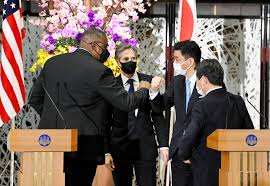
Defense Secretary Lloyd Austin in Tokyo on Tuesday. (Kim Kyung-Hoon/AFP/Getty Images) Opinion by Columnist March 18, 2021 at 3:30 p.m. PDT On the eve of his visit this week to Asia, Defense Secretary Lloyd Austin outlined his key concern. “China is our pacing threat,” he said. He explained that for the past 20 years, the United States had been focused on the Middle East while China had been modernizing its military. “We still maintain the edge,” he noted, “and we’re going to increase the edge going forward.” Welcome to the new age of bloated Pentagon budgets, all to be justified by the great Chinese threat. What Austin calls America's “edge” over China is more like a chasm. The United States has about 20 times the number of nuclear warheads as China. It has twice the tonnage of warships at sea, including 11 nuclear-powered aircraft carriers compared with china's two carriers (which are much less advanced). Washington has more than 2,000 modern fighter jets compared with Beijing’s roughly 600, according to national security analyst Sebastien Roblin. And theUnited Statesdeploys this power using a vast network of some 800 overseas bases. China has three. China spends around $250 billion on its military, a third as much as the United States. Michael O’Hanlon of the Brookings Institution notes that “if China were in NATO, we would berate it for inadequate burden-sharing since its military outlays fall well below NATO’s 2 percent minimum.” At the height of its imperial might in the late 19th century, when it ruled a quarter of the world’s population, Britain adopted a “two-power standard” — its navy had to be larger than the next two put together.U.S.military spending remains larger than the defense budgets of the next 10 countries put together, most of which are Washington’s close allies. TheUnited States’ intelligence budget alone — around $85 billion — is larger than Russia’s total defense spending. And yet theUnited States never imagines that this kind of spending could ever be seen by other countries as threatening. In requesting even more money for his region, the head of the Indo-Pacific Command, Adm. Philip S. Davidson, remarked on China’s increases in defense spending: “I cannot for the life of me understand some of the capabilities that they’re putting in the field unless it is an aggressive posture.” But the fact that Washington is spending more on the military than it did at the height of the Vietnam War (even accounting for inflation) should threaten no one? In any case, the size of military spending is a misleading indicator of strength. Far more important are the objectives sought and the political-military strategy used to achieve those objectives. The United States has probably outspent the Taliban 10,000 to 1 in Afghanistan. And yet Washington has been unable to achieve its objective there — ensuring that the Kabul government rules the country uncontested. If the United States defines its goals carefully and assembles an intelligent and consistent political and military strategy to achieve them, it can succeed. Without that, millions of troops and trillions of dollars will not guarantee victory. Bigness is not a substitute for brains. Consider two contrasting exercises of power. The United States’ F-35 fighter jet program, bedeviled by cost overruns and technical problems, will ultimately cost taxpayers $1.7 trillion. China will spend a comparable amount of money on its Belt and Road Initiative, an ambitious set of loans, aid, and financing for infrastructure throughout the world, aimed at creating greater interdependence with dozens of countries that are important to Beijing. Which is money better spent? The Pentagon operates in a realm apart from any other government agency. It spends money on a scale that is almost unimaginable — and the waste is, too. Every government agency is required to audit its accounts, but for decades, the Pentagon simply flouted this law. In 2018, it finally obeyed, paying $400 million for 1,200 auditors to examine its books, yet it still could not get a clean bill of health. As writer Matt Taibbi noted in a brilliant 2019 exposé of Pentagon accounting, the auditors “were unable to pass the Pentagon or flunk it. They could only offer no opinion, explaining the military’s empire of hundreds of acronymic accounting silos was too illogical to penetrate.” The Defense Department has failed to pass two more audits since then. Having spent two decades fighting wars in the Middle East without much success, the Pentagon will now revert to its favorite kind of conflict, a cold war with nuclear power. It can raise endless amounts of money to “outpace” China, even if nuclear deterrence makes it unlikely there will be an actual fighting war in Asia. Of course, there might be budget wars in Washington — but those are the battles that the Pentagon knows how to win! |
|
|
 |
 |
| 實用資訊 | |
|
|
| 一周點擊熱帖 | 更多>> |
| 一周回復熱帖 |
| 歷史上的今天:回復熱帖 |
| 2020: | 趙立堅要求知道真相,何錯之有? | |
| 2020: | 當北美病夫開始耍流氓的時候…… | |
| 2019: | 為什麼有沒有人監督你都要愛國 | |
| 2019: | 習近平攫取終身權力警醒西方反擊 | |
| 2018: | 川普只有停止跟中國的一切貿易才能打贏 | |
| 2018: | 胡平| 支持《台灣旅行法》 | |
| 2017: | 貼一張海平面的照片,我反正是看不出一 | |
| 2017: | 尼古拉·特斯拉 - 他就是神本身 | |
| 2016: | 江青至死沒有離開過秦城監獄,真實死因 | |
| 2016: | 小思:李克強與習近平關係不好嗎? | |
