



| U.S. Naval Deployments: Global Strategy |
| 送交者: renqiulan 2025年09月30日17:01:14 於 [天下論壇] 發送悄悄話 |
|
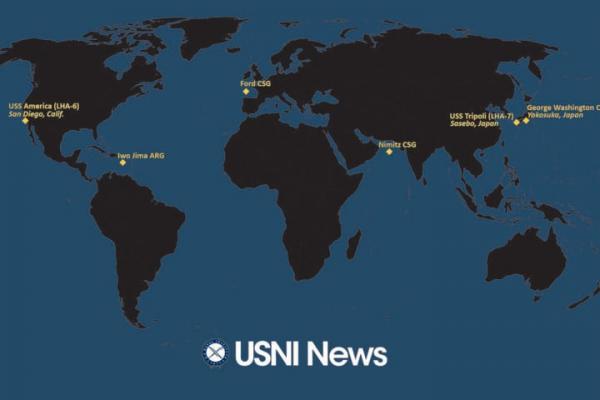
The U.S. Navy’s worldwide presence is one of Washington’s most potent tools for deterrence, reassurance, and power projection. The snapshot from September 29, 2025, published by USNI News, provides a useful window into how the United States is deploying its carrier strike groups (CSGs) and amphibious ready groups (ARGs) at a moment of mounting global tension. What stands out immediately is both the geographical spread and the concentration of forces in the Indo-Pacific, alongside the relative scarcity of deployments elsewhere. 1. The Indo-Pacific: Center of Gravity The map shows three major U.S. naval forces deployed in and around Japan: • USS Tripoli (LHA-7), Sasebo (佐世保), Japan • USS George Washington (CVN-73), Yokosuka(橫須賀), Japan • Forward presence of rotational assets in the region The Pacific is clearly the epicenter of U.S. naval strategy. The deployment of George Washington, one of America’s Nimitz-class aircraft carriers, in Yokosuka underscores the Navy’s long-standing commitment to maintaining a forward-deployed carrier in Japan. This guarantees that Washington can respond rapidly to crises in the Taiwan Strait, the South China Sea, or the Korean Peninsula. Meanwhile, USS Tripoli—an America-class amphibious assault ship—stationed in Sasebo adds another layer of capability. Although officially classified as an amphibious warship, the America-class can embark F-35B stealth fighters, effectively making it a “light carrier.” Its presence suggests a focus on flexible, distributed maritime operations: smaller carriers and amphibious ships working in tandem with larger CSGs to complicate adversary targeting and extend operational reach. Together, these deployments reflect U.S. strategy aimed at deterring China’s assertiveness and North Korea’s volatility. The clustering around Japan ensures the U.S. can pivot forces south toward Taiwan and the South China Sea or north toward the Korean Peninsula with minimal delay. 2. The Middle East: Sustained Engagement In the Arabian Sea or nearby waters, the Nimitz Carrier Strike Group is marked on the map. This is significant because the U.S. has, over the past decade, tried to reduce its naval footprint in the Middle East in order to free up assets for the Indo-Pacific. Yet the presence of Nimitz here indicates continuing instability—whether tied to Iranian naval harassment in the Strait of Hormuz, unrest in Yemen, or broader concerns about maritime chokepoints. Keeping a carrier strike group in the region is a costly but telling commitment. It reflects Washington’s desire to reassure regional allies such as Saudi Arabia, Israel, and the Gulf states, while signaling to Tehran that the U.S. retains the capacity to enforce freedom of navigation in one of the world’s most vital oil transit routes. 3. The Atlantic: A New Balance The Ford Carrier Strike Group, centered on the Navy’s newest and most advanced supercarrier, is shown operating in the Atlantic. Unlike in past decades, when the Atlantic was seen primarily as a transit zone for U.S. carriers moving to Europe or the Mediterranean, today’s Atlantic deployments serve a different purpose. They are aimed at countering a resurgent Russia in the High North and reassuring NATO allies. The Gerald R. Ford (CVN-78) offers a quantum leap in capabilities: electromagnetic catapults, advanced radar, and improved sortie generation rates. Its operations in the Atlantic are not merely symbolic—they are a practical demonstration to both allies and adversaries that the U.S. is committed to maintaining maritime dominance in waters increasingly contested by Russian submarines. 4. The Americas: Homeland Anchors The map shows USS America (LHA-6) in San Diego, California, and the Iwo Jima Amphibious Ready Group off the U.S. East Coast or Caribbean region. These deployments indicate two important functions: • Homeport readiness: Ships like USS America in San Diego are central to training cycles, maintenance, and preparation for forward deployment. Their presence also signals that, while some assets are abroad, others are cycling through maintenance and readiness at home. • Western Hemisphere presence: The Iwo Jima ARG may be supporting exercises, humanitarian missions, or Caribbean patrols. Amphibious ready groups are versatile, able to carry Marines, helicopters, and landing craft, making them useful for both combat operations and disaster relief. Their location underscores the Navy’s role not only in global deterrence but also in regional stability close to home. 5. Observations on Distribution and Strategy What is perhaps most striking about this snapshot is the limited number of carrier strike groups at sea—two forward deployed (George Washington and Nimitz) plus Ford in the Atlantic. This is a reminder of the stress on U.S. carrier availability: of eleven operational carriers, only a fraction are at sea at any given moment, with others in maintenance or training. The heavy Indo-Pacific presence highlights America’s strategic prioritization of countering China, but it also reveals how thinly stretched the fleet can appear. The U.S. cannot simultaneously maintain strong carrier presence in the Mediterranean, Middle East, and Pacific without strain. Thus, it relies increasingly on ARGs and light carriers like America andTripoli to provide flexible options. 6. Conclusion The 9/ 29/2025 snapshot of U.S. fleet deployments illustrates a Navy balancing global commitments under resource constraints. The Indo-Pacific emerges as the priority theater, with Japan hosting both a nuclear-powered supercarrier and a modern amphibious assault ship. The Middle East remains too volatile to ignore, hence the deployment of Nimitz. The Atlantic, once an afterthought, is now a stage for showcasing America’s newest carrier to NATO and Russia. And closer to home, amphibious ships underscore the Navy’s role in readiness and regional security. This distribution underscores both the flexibility and the limitations of American seapower. It projects deterrence where it matters most, but also highlights the immense logistical strain of maintaining a global naval presence with a finite number of carriers and amphibious ships. Last but not least, no one should ever forget all those unparalleled U.S. submarines. They may not be in the picture, but they are always fully capable of stealing the show. Author: renqiulan |
|
|
 |
 |
| 實用資訊 | |
|
|
| 一周點擊熱帖 | 更多>> |
| 一周回復熱帖 |
| 歷史上的今天:回復熱帖 |
| 2024: | 問以色列總理內坦尼亞狐吉凶( 8:48:32 | |
| 2024: | 到底誰是SB? | |
| 2023: | 許家印與任正非的區別就是“妻不如妾妾 | |
| 2023: | 馬黑抄來的文宣問題在哪? | |
| 2022: | 天不變道亦不變,包子窩頭隨便 | |
| 2022: | 普京的核賭註:全國動員、 炸毀北溪管 | |
| 2021: | 中共朝甚除,田甚蕪,倉甚虛,我在2020 | |
| 2021: | 清零失靈澳洲解禁,厲害國羞死 | |
| 2020: | 中秋懷鄉 | |
| 2020: | 川白首辯,CNN白說。 | |
