



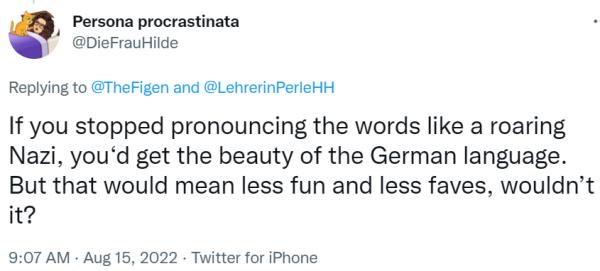
| 可怕的德語與葡語英語相比每個德語單詞發音都像咆哮的納粹阿道夫 |
| 送交者: Pascal 2022年08月18日23:59:29 於 [五 味 齋] 發送悄悄話 |
|
全球 5,500,000 次 觀看
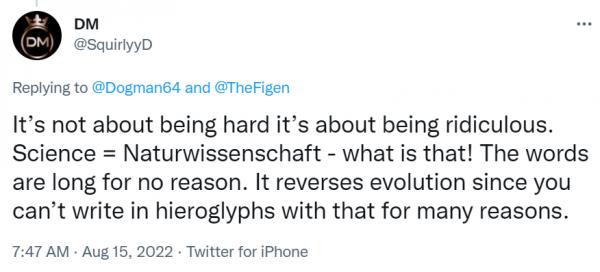
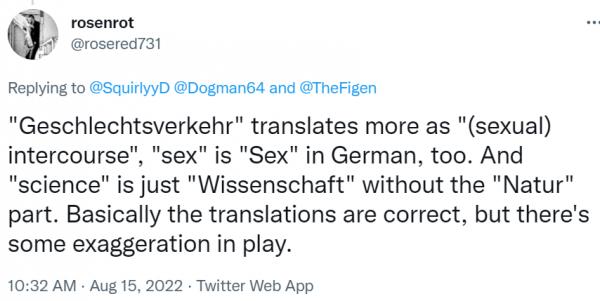
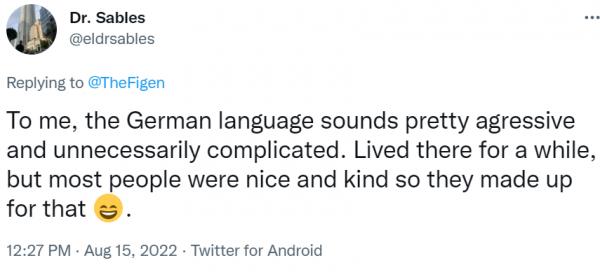
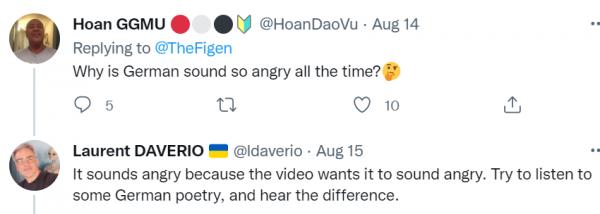
不是戲說德語發音既狠且硬,而是在譏它的繁瑣, 一個 科學 單詞,弄那麼老長幹嘛?
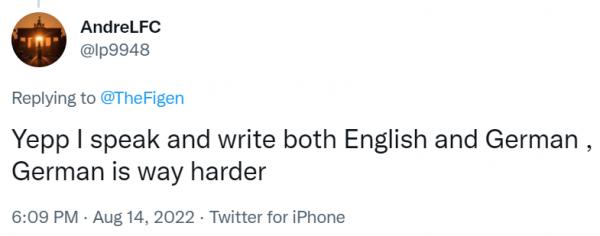
我能說能寫英語德語, 德語比英語難得太多了!
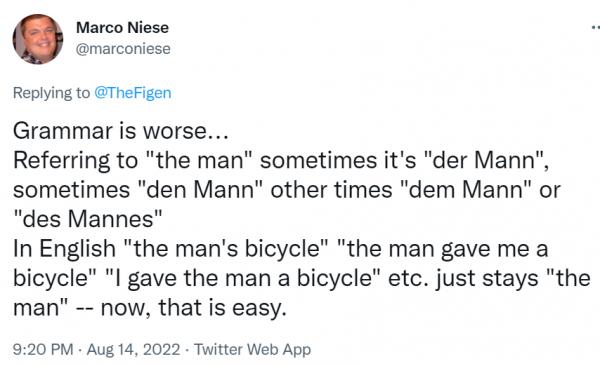
德語 —— 沒有必要地整那麼複雜
我的母語是德語, 學起英語來,實在太簡單了!
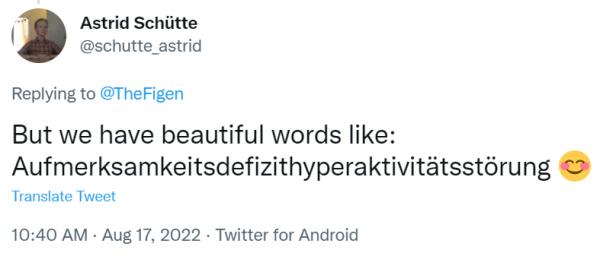
我們也有美麗的德語單詞 —— Aufmerksamkeitsdefizithyperaktivitätsstörung 注意力缺陷多動障礙 有語言天賦的人學英語,30個小時就夠了; 學法語得要30天;德語呢,得生生學它30年。 The Awful German LanguageMark Twain 1880from A Tramp AbroadA little learning makes the whole world kin. I went often to look at the collection of curiosities in Heidelberg Castle, and one day I surprised the keeper of it with my German. I spoke entirely in that language. He was greatly interested; and after I had talked a while he said my German was very rare, possibly a "unique"; and wanted to add it to his museum. If he had known what it had cost me to acquire my art, he would also have known that it would break any collector to buy it. Harris and I had been hard at work on our German during several weeks at that time, and although we had made good progress, it had been accomplished under great difficulty and annoyance, for three of our teachers had died in the mean time. A person who has not studied German can form no idea of what a perplexing language it is. Surely there is not another language that is so slipshod and systemless, and so slippery and elusive to the grasp. One is washed about in it, hither and thither, in the most helpless way; and when at last he thinks he has captured a rule which offers firm ground to take a rest on amid the general rage and turmoil of the ten parts of speech, he turns over the page and reads, "Let the pupil make careful note of the following EXCEPTIONS." He runs his eye down and finds that there are more exceptions to the rule than instances of it. So overboard he goes again, to hunt for another Ararat and find another quicksand. Such has been, and continues to be, my experience. Every time I think I have got one of these four confusing "cases" where I am master of it, a seemingly insignificant preposition intrudes itself into my sentence, clothed with an awful and unsuspected power, and crumbles the ground from under me. For instance, my book inquires after a certain bird--(it is always inquiring after things which are of no sort of no consequence to anybody): "Where is the bird?" Now the answer to this question--according to the book--is that the bird is waiting in the blacksmith shop on account of the rain. Of course no bird would do that, but then you must stick to the book. Very well, I begin to cipher out the German for that answer. I begin at the wrong end, necessarily, for that is the German idea. I say to myself, "REGEN (rain) is masculine--or maybe it is feminine--or possibly neuter--it is too much trouble to look now. Therefore, it is either DER (the) Regen, or DIE (the) Regen, or DAS (the) Regen, according to which gender it may turn out to be when I look. In the interest of science, I will cipher it out on the hypothesis that it is masculine. Very well--then THE rain is DER Regen, if it is simply in the quiescent state of being MENTIONED, without enlargement or discussion--Nominative case; but if this rain is lying around, in a kind of a general way on the ground, it is then definitely located, it is DOING SOMETHING--that is, RESTING (which is one of the German grammar's ideas of doing something), and this throws the rain into the Dative case, and makes it DEM Regen. However, this rain is not resting, but is doing something ACTIVELY,--it is falling--to interfere with the bird, likely--and this indicates MOVEMENT, which has the effect of sliding it into the Accusative case and changing DEM Regen into DEN Regen." Having completed the grammatical horoscope of this matter, I answer up confidently and state in German that the bird is staying in the blacksmith shop "wegen (on account of) DEN Regen." Then the teacher lets me softly down with the remark that whenever the word "wegen" drops into a sentence, it ALWAYS throws that subject into the GENITIVE case, regardless of consequences--and therefore this bird stayed in the blacksmith shop "wegen DES Regens." N.B.--I was informed, later, by a higher authority, that there was an "exception" which permits one to say "wegen DEN Regen" in certain peculiar and complex circumstances, but that this exception is not extended to anything BUT rain. There are ten parts of speech, and they are all troublesome. An average sentence, in a German newspaper, is a sublime and impressive curiosity; it occupies a quarter of a column; it contains all the ten parts of speech--not in regular order, but mixed; it is built mainly of compound words constructed by the writer on the spot, and not to be found in any dictionary--six or seven words compacted into one, without joint or seam--that is, without hyphens; it treats of fourteen or fifteen different subjects, each enclosed in a parenthesis of its own, with here and there extra parentheses, making pens with pens: finally, all the parentheses and reparentheses are massed together between a couple of king-parentheses, one of which is placed in the first line of the majestic sentence and the other in the middle of the last line of it--AFTER WHICH COMES THE VERB, and you find out for the first time what the man has been talking about; and after the verb--merely by way of ornament, as far as I can make out--the writer shovels in "HABEN SIND GEWESEN GEHABT HAVEN GEWORDEN SEIN," or words to that effect, and the monument is finished. I suppose that this closing hurrah is in the nature of the flourish to a man's signature--not necessary, but pretty. German books are easy enough to read when you hold them before the looking-glass or stand on your head--so as to reverse the construction--but I think that to learn to read and understand a German newspaper is a thing which must always remain an impossibility to a foreigner. Yet even the German books are not entirely free from attacks of the Parenthesis distemper--though they are usually so mild as to cover only a few lines, and therefore when you at last get down to the verb it carries some meaning to your mind because you are able to remember a good deal of what has gone before. Now here is a sentence from a popular and excellent German novel--which a slight parenthesis in it. I will make a perfectly literal translation, and throw in the parenthesis-marks and some hyphens for the assistance of the reader--though in the original there are no parenthesis-marks or hyphens, and the reader is left to flounder through to the remote verb the best way he can: "But when he, upon the street, the (in-satin-and-silk-covered- now-very-unconstrained-after-the-newest-fashioned-dressed) government counselor's wife MET," etc., etc. [1] ... ... ... 可怕的德語馬克·吐溫 1880來自國外的流浪漢一點點的學習,讓整個世界變得親近。 我經常去看海德堡城堡的珍品收藏,有一天我用我的德語給了它的看守人一個驚喜。我完全用那種語言說話。他非常感興趣。我聊了一會兒,他說我的德語很稀有,可能是“獨一無二的”;並想將其添加到他的博物館中。 如果他知道我為獲得我的藝術品付出了多少代價,他也會知道購買它會讓任何收藏家崩潰。在那段時間裡,我和哈里斯一直在努力學習我們的德語,雖然我們取得了不錯的進步,但還是在極大的困難和煩惱中完成了,因為我們的三位老師同時去世了。一個沒有學過德語的人無法理解它是一種多麼令人困惑的語言。 肯定沒有另一種語言如此草率和無系統,如此狡猾和難以掌握。一個人在裡面四處漂流,以最無助的方式;最後,當他認為他已經掌握了一條規則,可以在十個詞類的普遍憤怒和混亂中提供堅實的基礎,以休息時,他翻過一頁,讀到:“讓學生仔細記下以下例外。” 他低頭看了看,發現規則的例外情況比它的實例要多。於是他再次落水,去尋找另一個亞拉臘,尋找另一個流沙。這一直是,並將繼續是我的經歷。每當我認為我掌握了這四個令人困惑的“案例”之一時,一個看似微不足道的介詞就會闖入我的句子,披着可怕而出人意料的力量,從我腳下粉碎大地。例如,我的書詢問某隻鳥——(它總是在詢問對任何人都無關緊要的事情):“那隻鳥在哪裡?” 現在這個問題的答案——根據這本書——是那隻鳥因為下雨而在鐵匠鋪里等着。當然沒有鳥會那樣做,但是你必須堅持這本書。很好,我開始用德語破解這個答案。我的出發點必然是錯誤的,因為那是德國人的想法。我對自己說,“REGEN(雨)是陽性的——或者它可能是陰性的——或者可能是中性的——現在看太麻煩了。因此,它要麼是 DER(the)Regen,要麼是 DIE(the ) 再生,或 DAS (the) Regen,根據我看時可能會發現的性別。為了科學的利益,我將根據它是男性的假設對其進行加密。很好——那麼 THE rain 就是 DER Regen,如果它只是處於被提及的靜止狀態,沒有擴大或討論——主格;但是如果這雨在周圍,以一種一般的方式在地面上,那麼它肯定是定位的,它正在做某事——也就是說,休息(這是德語語法中做某事的想法之一),並且這將雨水注入 Dative 案例,並使其成為 DEM Regen。然而,這場雨並沒有停止,而是在積極地做一些事情——它正在下落——可能會干擾鳥兒——這表明運動,它具有將其滑入賓格並改變 DEM Regen 的效果進入 DEN Regen。” 完成這件事的語法占星後,我自信地回答並用德語陳述這隻鳥留在鐵匠鋪“wegen (on account of) DEN Regen”。然後老師輕輕地讓我失望,說每當“wegen”這個詞進入一個句子時,它總是把那個主題扔進GENITIVE格,不管後果如何——因此這隻鳥留在了鐵匠鋪“wegen DES Regens” 。” 注意——後來,我被更高的權威告知,有一個“例外”允許人們在某些特殊和複雜的情況下說“wegen DEN Regen”,但這個例外不適用於除下雨之外的任何事情。 詞性有十個,都很麻煩。在德國報紙上,一句普通的句子是一種崇高而令人印象深刻的好奇心;它占據一列的四分之一;它包含了所有的十個詞類——不是按規則的順序,而是混合的;主要由作者現場構築的複合詞構成,在任何字典中都找不到——六七個詞緊縮成一個,沒有接縫或接縫——也就是沒有連字符;它處理十四或十五個不同的主題,每個主題都用自己的括號括起來,到處都有額外的括號,用筆做筆:最後,所有的括號和重新括號都集中在一對大括號之間,其中一個放在majestic句子的第一行,另一個放在最後一行的中間——在動詞之後,你第一次發現這個人在說什麼;在動詞之後——據我所知,這只是一種裝飾——作者用“HABEN SIND GWESEN GEHABT HAVEN GEWORDEN SEIN”或類似的詞來鏟起,紀念碑就完成了。我想這個結束的歡呼是一個男人簽名的繁榮的本質——不是必要的,但很漂亮。當你把德國書放在鏡子前或站在你的頭上時,它們很容易閱讀——以扭轉這種結構——但我認為學習閱讀和理解一份德國報紙是必須始終做到的事情對外國人來說仍然是不可能的。你第一次知道這個人在說什麼;在動詞之後——據我所知,這只是一種裝飾——作者用“HABEN SIND GWESEN GEHABT HAVEN GEWORDEN SEIN”或類似的詞來鏟起,紀念碑就完成了。我想這個結束的歡呼是一個男人簽名的繁榮的本質——不是必要的,但很漂亮。當你把德國書放在鏡子前或站在你的頭上時,它們很容易閱讀——以扭轉這種結構——但我認為學習閱讀和理解一份德國報紙是必須始終做到的事情對外國人來說仍然是不可能的。你第一次知道這個人在說什麼;在動詞之後——據我所知,這只是一種裝飾——作者用“HABEN SIND GWESEN GEHABT HAVEN GEWORDEN SEIN”或類似的詞來鏟起,紀念碑就完成了。我想這個結束的歡呼是一個男人簽名的繁榮的本質——不是必要的,但很漂亮。當你把德國書放在鏡子前或站在你的頭上時,它們很容易閱讀——以扭轉這種結構——但我認為學習閱讀和理解一份德國報紙是必須始終做到的事情對外國人來說仍然是不可能的。 然而,即使是德文書籍也並非完全不受括號瘟熱的影響——儘管它們通常很溫和,只涵蓋幾行,因此當你最終談到動詞時,它會給你帶來一些意義,因為你能夠記住很多以前發生的事情。下面是一本流行的優秀德國小說中的一句話——裡面有一個小括號。我將做一個完美的直譯,並加上括號和一些連字符以幫助讀者——儘管原文中沒有括號或連字符,讀者只能掙扎到遠程用他能做到的最好的方式動詞: “但是當他,在街上,(穿着緞面和絲綢的——現在非常不受約束的——在最新的時尚穿着之後)政府顧問的妻子遇到了,”等等,等等。[1 ] ...... ...... ...... https://faculty.georgetown.edu/jod/texts/twain.german.html https://en.wikipedia.org/wiki/The_Awful_German_Language |


|
 | |
|

 |
| 實用資訊 | |
|
|
| 一周點擊熱帖 | 更多>> |
| 一周回復熱帖 |
| 歷史上的今天:回復熱帖 |
| 2021: | 偉大的毛主席,紀念818 | |
| 2021: | runqun把台灣比作科威特,是分裂主義者 | |
| 2020: | 揭開魯九的真面目 | |
| 2020: | 王丹,烏爾凱西,柴玲都是中國的Antifa. | |
| 2019: | 熱血紅旗!海外華人用自己的方式來愛國 | |
| 2019: | 香港8.18遊行 | |
| 2018: | 慶瘋帝的新聞 | |
| 2018: | 我昨晚觀察月亮了,月亮里的兔子耳朵對 | |
| 2017: | 班農離開白宮預示着什麼? | |
| 2017: | 今天的明鏡採訪,郭文貴同時向習伸出橄 | |
