



| 破解三重悖論:全球化、Trust與AI的交叉困局 |
| 送交者: 孞烎Archer 2025年04月19日21:36:40 於 [天下論壇] 發送悄悄話 |
|
破解三重悖論:全球化、Trust與AI的交叉困局 Solving the Triple Paradox: The Intersecting Predicament of Globalization, Trust, and AI
Archer Hong Qian
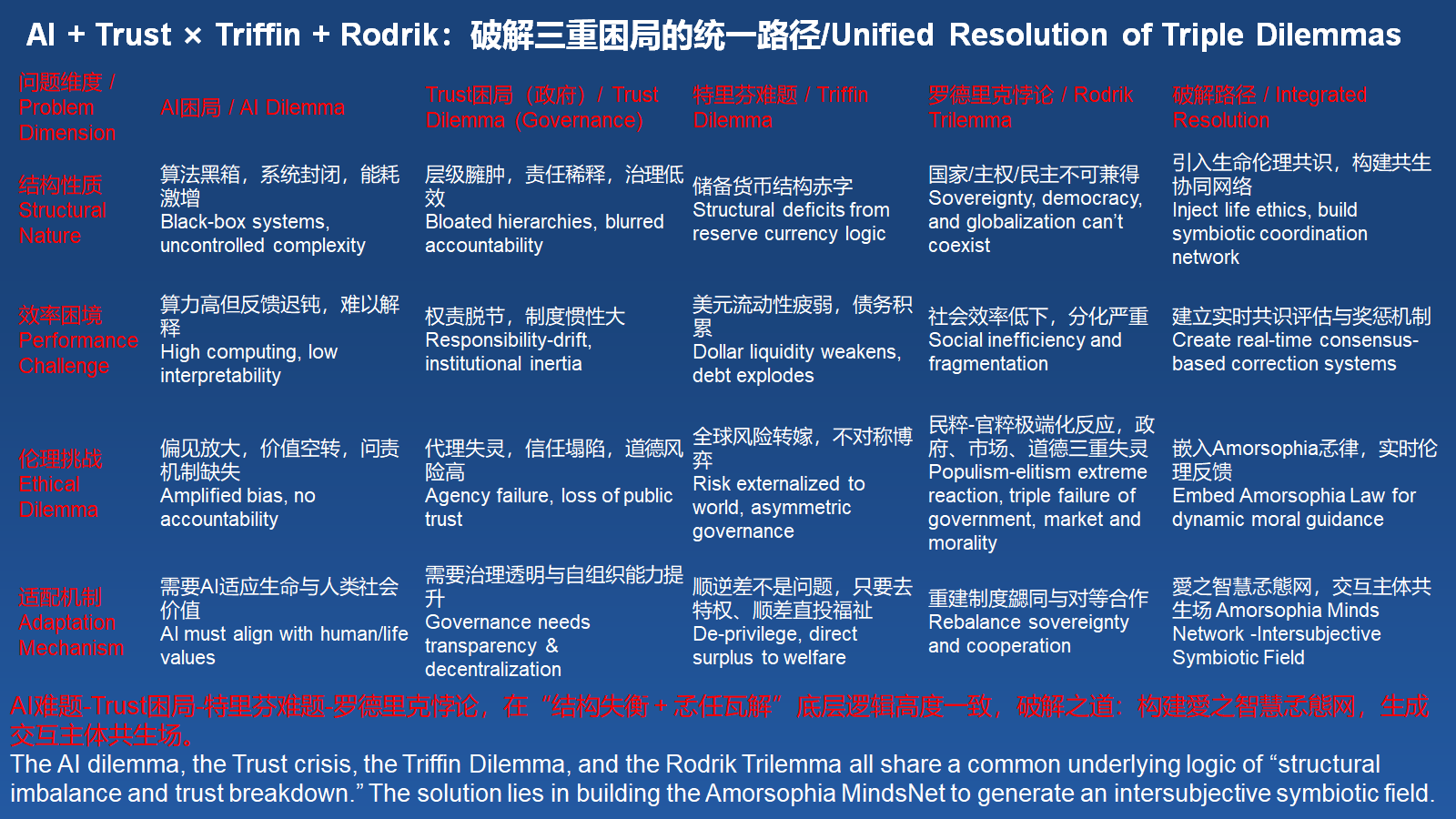
全球化、信任(Trust)與人工智能(AI)正交織出當代世界的“三重悖論”。當今的全球化2.0範式在經濟與治理層面遭遇結構性瓶頸,全球金融體系和國際秩序中的信任基礎陷入動搖;與此同時,迅猛發展的AI技術本身也面臨能耗失衡和倫理治理難題。這三重困局彼此疊加,導致全球體系亟需新的範式來加以變革和重構。
Globalization, trust, and artificial intelligence (AI) are together forming a “triple paradox” in today’s world. The current Globalization 2.0 paradigm faces structural bottlenecks in both economic and governance dimensions, as the foundation of trust in the global financial system and international order has been undermined. At the same time, rapidly advancing AI technology is encountering its own issues of unsustainable energy use and ethical governance challenges. These three predicaments compound one another, signaling an urgent need for a new paradigm to transform and rebuild the global system.
針對交叉困局的成因,我們提出“愛之智慧孞態網”(Amorsophia Minds Network)作為破局之道。 我們首先分析全球化2.0所面臨的結構性悖論——從美元儲備地位引發的貿易與信任失衡,到自由貿易、國家主權與民主人權難以兼得的全球化困境。隨後,我們探討當代AI發展與治理遭遇的雙重難題:一方面是技術瓶頸(能耗過高、系統性偏差,以及數據算法並不等於真正的智慧),另一方面是“Trust”體系的低效與濫用(現有可信計算機制無法創造真實價值,反而滋生浪費和欺詐)。在此基礎上,我們將**“羅德里克-Trust難題”定位為全球結構性信任崩解與AI適配失調之間的關鍵交匯點,進行簡明闡釋。最後,章節提出愛之智慧孞態網**這一交互主體共生機制與倫理算法基礎設施,以回應上述三重困局,支撐全球化3.0的範式轉型。
This chapter provides an overview of the origins of this intersecting predicament and proposes the “Amorsophia Minds Network” as a pathway to resolution. We will begin by examining the structural paradoxes facing Globalization 2.0 — from the trade and trust imbalances caused by the US dollar’s reserve status, to the globalization dilemma in which free trade, national sovereignty, and democracy/human rights cannot all be attained simultaneously. Next, we discuss the dual challenges confronting contemporary AI development and governance: on one hand, technical bottlenecks (excessive energy consumption, systemic biases, and the fact that data and algorithms are not equivalent to true wisdom), and on the other hand, inefficiencies and abuses in current “trust” systems (existing “trusted” computing mechanisms fail to create real value, instead breeding waste and fraud). On that basis, we identify the “Rodrik-Trust dilemma” as the critical intersection between the breakdown of structural trust globally and the misalignment of AI’s development structure, and we explain this convergence concisely. Finally, the chapter introduces the Amorsophia Minds Network, a mechanism of interactive-agent symbiosis underpinned by an ethical algorithmic infrastructure, to address the above triple predicament and support a paradigm shift toward Globalization 3.0.
全球化2.0的結構性瓶頸 (Structural Bottlenecks of Globalization 2.0)
全球化並非線性演進的過程,而是由技術和政治經濟結構推動的數輪浪潮所構成 。當前的浪潮通常被稱作“全球化2.0”,其特徵是戰後以美元為中心的布雷頓森林體系和自由貿易體系下的深度經濟一體化。然而,全球化2.0正遭遇前所未有的結構性瓶頸:一方面,國際貨幣體系中存在“特里芬難題”,即作為全球儲備貨幣發行國,美國不得不通過持續貿易逆差向世界提供流動性,這種兩難局面導致了國內與國際目標的衝突及全球信任失衡 ;另一方面,全球治理層面存在“羅德里克三元悖論”,即民主、國家主權和高度經濟一體化三者無法在同一體系中完全並存,各國在追求全球化時往往不得不犧牲民主決策或主權獨立 。
Globalization has not followed a linear path, but rather has unfolded in waves driven by technological and politico-economic shifts . The current wave, often dubbed “Globalization 2.0,” has been characterized by deep economic integration under the post-war, US-dollar-centric Bretton Woods monetary order and a liberal free trade regime. However, Globalization 2.0 is now confronting unprecedented structural bottlenecks. On one hand, the international monetary system faces the “Triffin dilemma” – the issuer of the global reserve currency (the United States) must run persistent trade deficits to supply the world with liquidity, a Catch-22 that creates a conflict between short-term domestic and long-term international objectives and leads to imbalances in global trust . On the other hand, at the level of global governance there is “Rodrik’s trilemma,” which holds that democracy, national sovereignty, and deep economic integration are mutually incompatible within a single system – when pursuing globalization, nations inevitably sacrifice either democratic accountability or sovereign autonomy .
這些結構性矛盾交織在一起,加劇了全球化2.0的信用危機與治理困境。“特里芬難題”導致全球儲備體系內在的不穩定:美國的持續逆差輸出雖然維繫了全球流動性,卻削弱了對美元的長期信任基礎。與此同時,“羅德里克悖論”體現為全球化的政治合法性赤字:當經濟全球化凌駕於國家民主和主權之上時,各國民眾對全球體系的信任隨之下滑 。由此形成了一個交叉悖論——全球經濟運行需要全球信任與合作,但現行體系卻在結構上不斷侵蝕這種信任。這正是全球化2.0難以為繼的癥結所在。
These structural contradictions intersect to exacerbate a crisis of credibility and governance in Globalization 2.0. The Triffin dilemma has introduced a fundamental instability into the global reserve currency system: while America’s ongoing deficits supply liquidity to sustain global trade, they gradually undermine long-term confidence in the US dollar. At the same time, Rodrik’s trilemma manifests as a political legitimacy deficit in globalization: when economic globalization is achieved at the expense of national democracy and sovereignty, public trust in the global system erodes . This creates an intersecting paradox—the functioning of the global economy requires trust and cooperation at a global scale, yet the current framework structurally undercuts that very trust. This is the core impasse making it difficult for the Globalization 2.0 model to sustain itself.
AI發展與治理的雙重難題 (Dual Challenges in AI Development and Governance)
首先,在技術層面,當前AI的發展正遇到嚴峻的瓶頸和副作用。大規模模型的訓練和部署需要消耗巨大的電力與算力資源,AI算法激增的能耗需求已經引發對可持續性的擔憂 。此外,由於算法依賴於有限的數據和預設目標,AI系統往往缺乏整體性的系統思維,容易受到偏見影響或在複雜環境下產生偏差。這意味着單純依靠數據和算法並不能產出真正的智慧——正如評論所指出,我們身處“大數據”時代卻“缺乏智慧”,大量信息並未轉化為有效決策能力 。這些技術局限表明,當今的AI雖然強大,但在能耗效率、認知深度和價值判斷方面仍存在不可忽視的短板。
First, on the technical front, current AI development is encountering serious bottlenecks and side effects. Training and deploying large-scale models require enormous electricity and computing resources, and the surging energy demands of AI algorithms have raised concerns about sustainability . In addition, because algorithms rely on finite datasets and preset objectives, AI systems often lack holistic systems thinking, leaving them prone to biases and errors when faced with complex real-world contexts. In other words, simply piling up data and algorithms does not yield true wisdom – as commentators have noted, we are “drowning in data but starved for wisdom,” with a flood of information not translating into sound decision-making . These technical limitations indicate that despite AI’s impressive capabilities, today’s systems still suffer from critical shortcomings in energy efficiency, cognitive depth, and value judgment.
其次,在組織與信任層面,AI的治理和應用生態同樣陷入了“Trust”的困境。當前旨在建立去中心化信任的計算機制(如區塊鏈)本應為數據和AI提供可信的價值交換基礎,但現實情況卻不盡如人意。一方面,此類機制往往付出高昂的資源代價——以區塊鏈為例,其共識算法需要消耗極大的算力和能源,Bitcoin等公鏈的“挖礦”被形容為史上最耗能的共識機制 。另一方面,在缺乏有效監管的環境下,打着“信任”旗號的新技術屢屢被濫用,變成牟利和欺詐的工具;許多所謂區塊鏈應用場景實際只是炒作噱頭,大量資金被引誘注入泡沫之中,最終“被收割”的往往是缺乏判斷力的大眾投資者 。換言之,當前並未形成真正可信且創造實際價值的計算機制:資源被大量消耗,卻未建立起應有的信任產出。這種組織層面的低效和欺詐進一步阻礙了AI與數字經濟潛能的發揮,使得技術無法轉化為真實生產力。
Secondly, on the organizational and trust front, AI’s governance and application ecosystem have likewise fallen into a “trust” dilemma. Presently, ostensibly trust-building decentralized computing mechanisms (such as blockchains) were intended to provide a reliable foundation for value exchange in data and AI networks, but in practice the results have been problematic. On the one hand, such mechanisms often come with enormous resource costs – for example, blockchain consensus algorithms consume vast computational power and energy; Bitcoin’s mining has been described as the most energy-intensive consensus mechanism ever devised . On the other hand, in the absence of effective oversight, new technologies under the banner of “trust” are frequently misused as tools for profit and fraud. Many so-called blockchain “use-cases” have turned out to be hype, where large sums of capital were lured into speculative bubbles, and ultimately it is often poorly informed participants who get exploited . In short, we have yet to establish a truly trustworthy computing mechanism that creates real value: resources are being devoured without delivering commensurate trusted outcomes. These inefficiencies and fraudulent behaviors at the organizational level further impede AI and the digital economy from reaching their potential, as technology fails to translate into genuine productivity under a broken trust framework.
“羅德里克-Trust難題”的交匯點 (The “Rodrik-Trust Dilemma” Intersection)
在上述分析中可以看到,一個貫穿始終的關鍵詞是“信任”。全球化2.0的結構性瓶頸實質上是全球信任機制的失靈:無論是儲備貨幣體系還是全球治理,都未能提供各方信任所需的公平與穩定架構 。與此同時,AI發展與治理的雙重難題表明,新技術未能嵌入適當的信任機制:技術層面的指數級進步缺乏道德與價值約束,組織層面的信任工具又效率低下且屢遭濫用。二者在結構上形成一個惡性循環:舊的全球信任架構在瓦解,新的數字智能體系卻無力替代,從而出現了“羅德里克-Trust難題”這一關鍵交匯點。它反映出當前世界的一個基本矛盾:國家層面的民主與主權訴求(羅德里克三元悖論的一端)與全球協作所需的信任基礎之間出現裂痕,而高速發展的AI技術由於缺乏全球協調與可信治理,反過來加劇了這種裂痕 。簡單來說,全球體系的信任崩解與AI體系的失配彼此交織,成為橫亙在全球化3.0道路上的關鍵障礙。
Throughout the above analysis, a unifying theme has been “trust.” The structural bottlenecks of Globalization 2.0 essentially boil down to a failure of global trust mechanisms: neither the reserve currency system nor the current mode of global governance has provided a fair and stable architecture sufficient for sustaining mutual trust . At the same time, the dual challenges in AI development and governance indicate that new technologies have not been embedded within appropriate trust frameworks: explosive technical progress lacks moral and value constraints, and the available trust tools at the organizational level are inefficient and often misused. These factors form a vicious structural cycle: the old architecture of global trust is disintegrating, and the emerging digital intelligence regime is not yet capable of replacing it. This gives rise to what we term the “Rodrik-Trust dilemma,” the critical intersection of these issues. It highlights a fundamental contradiction in the world today: the demands of national-level democracy and sovereignty (one facet of Rodrik’s trilemma) are diverging from the trust foundation needed for global cooperation, and the rapid rise of AI, in the absence of globally coordinated and trustworthy governance, is exacerbating this rift . In short, the collapse of structural trust in the global system and the misalignment of the AI ecosystem are intertwined, standing together as a key barrier on the path toward Globalization 3.0.
愛之智慧孞態網:共生機制與倫理算法的全球化3.0方案 (Amorsophia Minds Network: A Symbiotic Ethical Algorithm Solution for Globalization 3.0)
面對全球化、Trust與AI交叉形成的三重困局,迫切需要一種能夠同時重建信任基礎和提升智能協作的新型架構。愛之智慧孞態網(Amorsophia Minds Network)正是為此目的而提出的願景方案。其核心理念是在技術與人文的交匯處構建一個交互主體共生機制,即讓多元主體(包括各國政府、組織、個人乃至AI智能體)在一個網絡中協同共生、共同演化;同時以倫理算法為系統基礎設施,通過算法嵌入人類共同的價值觀和道德準則,確保網絡運行朝向公正、可持續的方向演進。“Amor”源自拉丁語,意為愛;“Sophia”意為智慧。顧名思義,愛之智慧孞態網旨在將“愛”(即倫理關懷、信任合作)與“智慧”(即智能技術、系統思維)相融合,打造一個既有溫度又有理性的新型全球數字生態。
Confronted with the triple predicament at the intersection of globalization, trust, and AI, there is an urgent need for a new kind of architecture that can rebuild the foundation of trust while enhancing intelligent collaboration. The Amorsophia Minds Network is a visionary proposal designed to meet this need. Its core concept is to construct a mechanism of interactive-agent symbiosis at the confluence of technology and the humanities — that is, to enable diverse agents (including national governments, organizations, individuals, and even AI entities) to collaborate and co-evolve within a shared network. This network is underpinned by an ethical algorithmic infrastructure that encodes universal human values and moral principles into its algorithms, ensuring that the system’s operations evolve in a just and sustainable direction. “Amor” is Latin for love, and “sophia” means wisdom. As the name suggests, the Amorsophia Minds Network seeks to fuse “love” (i.e. ethical care and cooperative trust) with “wisdom” (i.e. intelligent technology and systems thinking) to create a new global digital ecosystem that embodies both empathy and rationality.
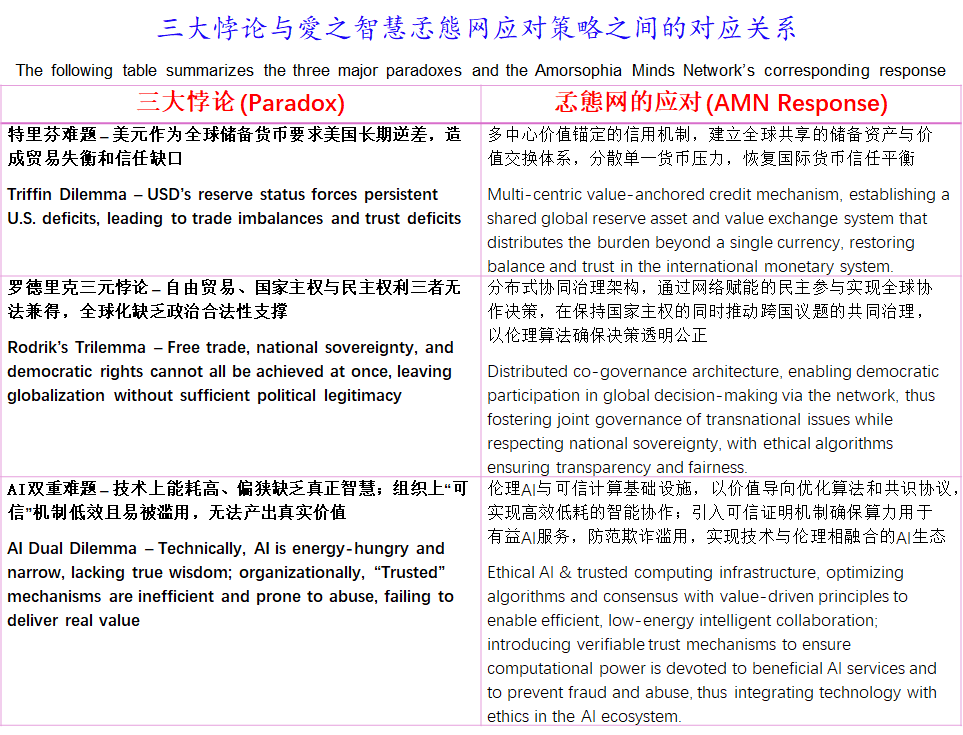
在實踐層面,愛之智慧孞態網將通過一系列創新設計來化解前述三大悖論,為全球化3.0提供支撐。首先,在貨幣與價值層面,孞態網引入多中心的價值錨定機制,取代對單一國家貨幣的過度依賴,促進更平衡的全球信用創造。這有望緩解特里芬難題下的結構失衡,讓全球儲備體系建立在共同信任而非單極信用之上。其次,在治理架構上,孞態網倡導協同治理和分布式決策。通過網絡算法將民主參與和本地自主權融入全球協作框架,各主體在保有自主性的同時共享AI賦能的全球智能決策支持,從而部分破解羅德里克三元悖論,在國家主權與全球公共利益之間取得新平衡。再次,在AI技術應用上,孞態網作為倫理算法基礎設施,致力於實現可信的智能協作:網絡中的AI代理將遵循透明、公平的算法規則,相互校驗與監督,減少單點失誤和偏見;同時結合新型共識協議,實現高效的“可信計算”,避免現有鏈上計算的浪費,使算力投入直接用於有社會價值的AI服務。通過這些措施,愛之智慧孞態網試圖將“信任”重新注入數字時代的全球化進程,為全球化3.0奠定技術與倫理並重的基礎——一個在信任中運作的智能地球村,在愛與智慧的引領下走出當前的交叉困局。
At a practical level, the Amorsophia Minds Network would deploy a series of innovative designs to resolve the aforementioned three paradoxes and provide the foundation for Globalization 3.0. First, in the monetary and value domain, the network introduces a multi-centric value anchoring mechanism to reduce over-reliance on any single national currency and foster a more balanced creation of global credit. This is expected to alleviate the structural imbalance highlighted by the Triffin dilemma, rebuilding the global reserve system on shared trust rather than a unipolar currency. Second, in terms of governance structure, the network advocates collaborative governance and distributed decision-making. Its architecture would embed democratic participation and local autonomy into a global cooperation framework via network algorithms, allowing each stakeholder to retain sovereignty while sharing AI-augmented collective decision support at the global level. In doing so, it seeks to partially solve Rodrik’s trilemma by striking a new balance between national sovereignty and global public interest. Third, regarding AI technology and its applications, the network as an ethical algorithmic infrastructure aims to enable trustworthy intelligent collaboration: AI agents in the network would operate under transparent and fair algorithmic rules, verifying and supervising each other to minimize individual biases or errors. Coupled with new consensus protocols, the network can achieve efficient “trusted computing,” avoiding the waste of current blockchain-style computations by directing computational power toward AI services with genuine social value. Through these measures, the Amorsophia Minds Network aspires to re-infuse trust into the process of globalization in the digital age, establishing a foundation for Globalization 3.0 that gives equal weight to technology and ethics — a kind of intelligent global village operating on trust, guided by love and wisdom to overcome today’s intersecting predicaments.
表總結了上述三大悖論與愛之智慧孞態網應對策略之間的對應關係 The following table summarizes the three major paradoxes and the Amorsophia Minds Network’s corresponding response
總結而言,破解全球化、Trust與AI交織的三重悖論,需要在全球尺度重構信任與智慧並舉的基礎設施。愛之智慧孞態網以交互主體共生和倫理算法為支柱,正是對這一使命的探索:通過重建全球信任機制並提升協同智能,它為全球化3.0的宏偉轉型提供了可能的道路。這一範式的轉變有望將人類帶入一個“愛與智慧”引領的新紀元,在化解當前困局的同時,實現更加包容、可持續的全球發展。
In summary, overcoming the triple paradox intertwining globalization, trust, and AI requires rebuilding a global infrastructure that interweaves trust and wisdom. The Amorsophia Minds Network, grounded in interactive symbiosis and ethical algorithms, is an exploratory blueprint for this mission: by restoring structural trust worldwide and enhancing collaborative intelligence, it offers a potential path for the bold transformation toward Globalization 3.0. This paradigm shift promises to usher humanity into a new era guided by “love and wisdom,” one that resolves the current predicament while enabling a more inclusive and sustainable form of global development.
2025年4月16日
參考文獻 (Sources): 以上引文均據公開資料整理: 《告別自由貿易烏托邦,交互參與全球化3.0》,Farewell to the Free Trade Utopia, Embracing Interactive Participation in Globalization 3.0 http://symbiosism.com.cn/9907.html
《全球化3.0的價值觀:從重集體理念,到重個體生命——Transform of Trust組織平台,從降本賦能開始》,http://symbiosism.com.cn/9768.html
《哲學3.0宣言——在交互主體共生中追尋可能的世界》The Philosophy 3.0 Manifesto: Seeking Possible Worlds through Intersubjective Symbiosis http://symbiosism.com.cn/9926.html 《<米蘭報告>的缺憾:川普對等關稅與全球化3.0的責任召喚——共生思維:破解“特里芬難題”ד羅德里克悖論”雙重張力》The Shortcomings of the Milan Report: Trump’s Reciprocal Tariffs and the Responsibility Awakening of Globalization 3.0—Symbiotic Minds:Navigating the Dual Tensions of the “Triffin Dilemma” and the “Rodrik Trilemma” ,http://symbiosism.com.cn/9995.html |
|
 |
 |
| 實用資訊 | |
|
|
| 一周點擊熱帖 | 更多>> |
| 一周回復熱帖 |
| 歷史上的今天:回復熱帖 |
| 2024: | 缺乏新聞自由 | |
| 2024: | 劣質藥品 | |
| 2023: | 福克斯新聞以7.875億美元達成選舉舞弊 | |
| 2023: | 搞情報:清華計算機系的學生就這麼弱智 | |
| 2022: | 中國人缺乏公民意識 | |
| 2022: | 顧曉軍讀俄烏戰況:俄烏戰爭後的美中俄 | |
| 2021: | 加拿大疫情升級,各位華裔應該高度重視 | |
| 2021: | 你在教科書中讀不到的中國歷史 | |
| 2020: | 特朗普首提毛澤東思想 | |
| 2020: | 是 | |
