



| Wei Liu: Making Rubber Stamp f |
| 送交者: 普通百姓12 2025年09月29日17:07:43 于 [史地人物] 发送悄悄话 |
|
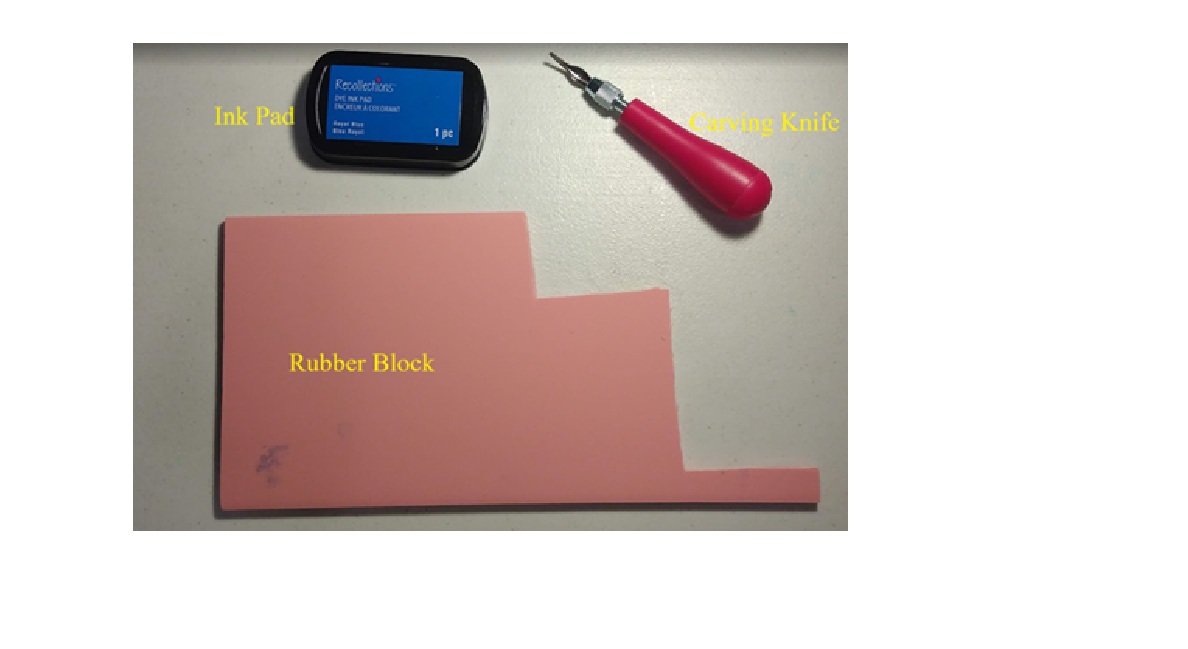
Wei Liu: Making Rubber Stamp for Democracy in China Wei Liu, U. S. citizen, U. S. veteran, California, September 2025 From 1949 to now 2025, China has been a Communist country, where Communist regards exercising freedom of speech as a crime. For common people in China, using a piece of paper to say words like “China Needs Freedom”, “Free China”, is doable, but it is not quite convenient. It needs a printer at home because outside printing shops dare not print it for you and may report you to Communist, who punishes you. When posting the paper, about 25 cm length, one needs to carry a bag, putting glue or tape on wall, with the time on site being several minutes. And after one posting the piece on the wall, it just takes Communist 2 seconds to tear it down. I have invented a technique that common people in China can do. It is to use carving knife to carve characters on rubber block. One needs to buy 3 items: carving knife, rubber block, ink pad, total about $50 in San Francisco Area in 2025. These items are sold in China too, about 100 Chinese yuan. Three items in America in Figure 1 looks as below (Photo by Author).
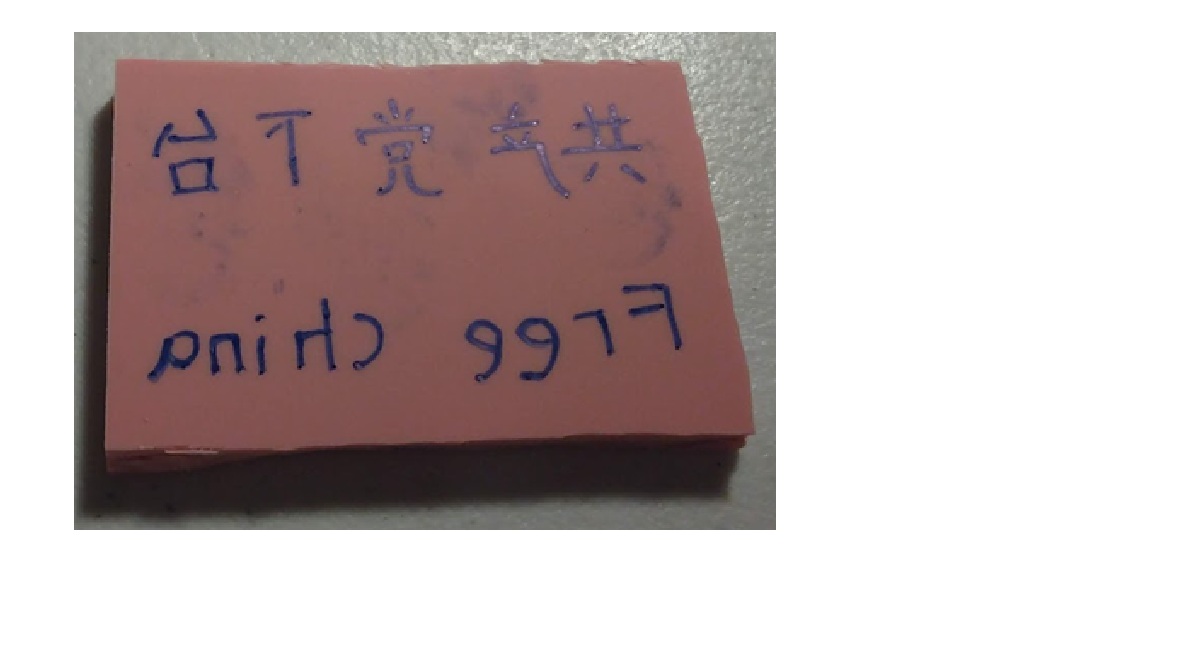
There are different ways to make Rubber Stamp. One is to keep the characters on higher area on rubber by making non-character area lower about 2 millimeters. Then when stamping, the background is white and the character is color. This way over 90% of area on rubber block needs to be carved or removed by 2 mm. My way is the opposite, carving/removing on the area of character, lowering it by about 2 mm. This way less than 10% of area on rubber block is carved or removed and over 90% of area is intact. When stamping, the background is color and the character is white. There are 3 steps in making the stamp. Step 1: Write characters on rubber block in reversed way, like “共产党下台,Free China” in Figure 2 looks as below (Photo by Author).
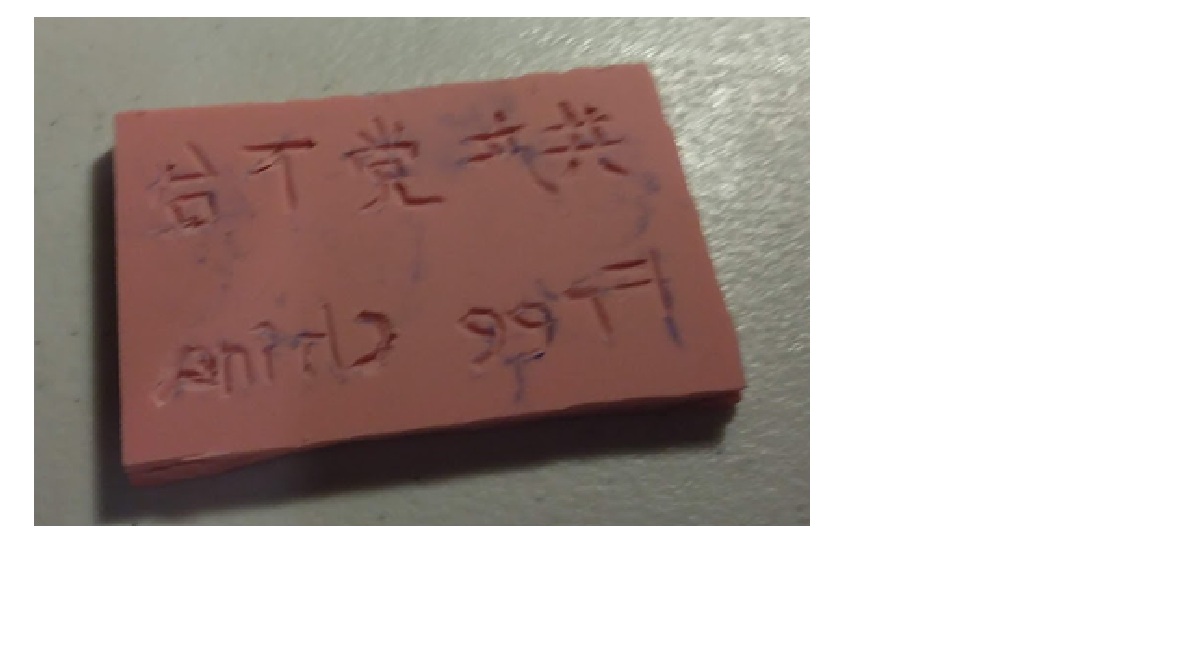
Free China, like Free Tibet, means China needs freedom and Chinese Communist Regime collapse. Step 2: Carve or removing material along the characters. The carved version in Figure 3 looks as below (Photo by Author).
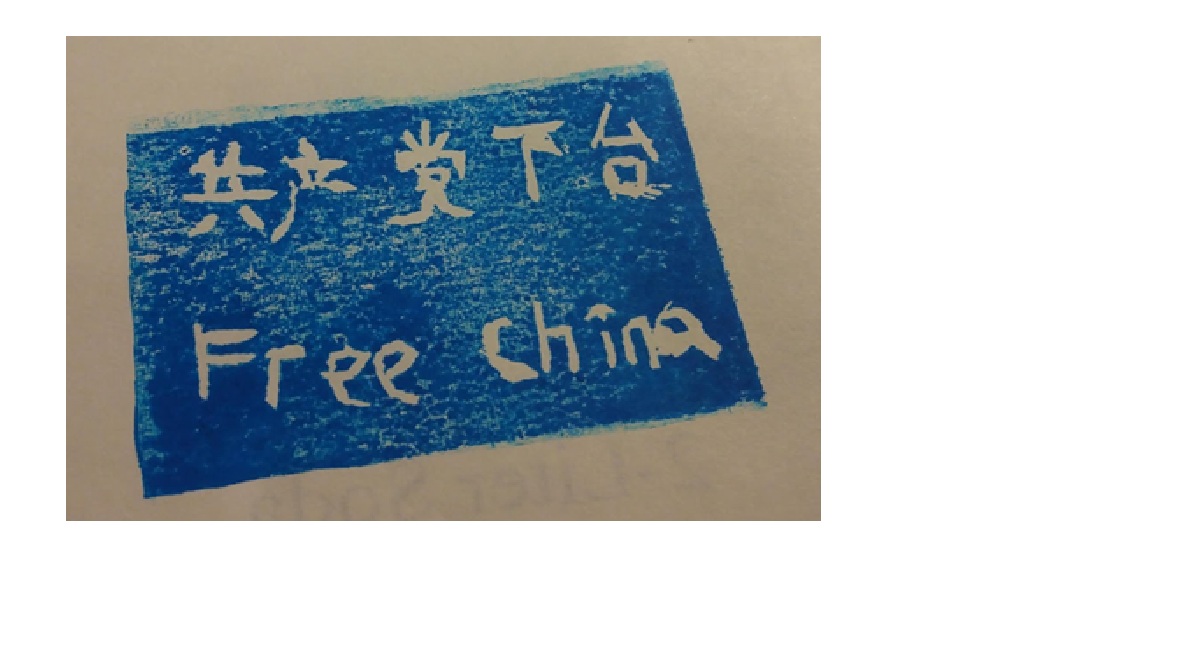
Step 3: Press rubber block on Ink Pad and then Press rubber block on surface. Rubber block is 5 cm long and 3 cm wide. It needs 7000 Pascal of pressure to stamp/print clearly on surface. How much force should be the force of human hand? Solution: 5 cm = 0.05 m 3 cm = 0.03 m Area = Length*Width = 0.05 * 0.03 = 0.0015 cm2 Pressure = Force/Area (Esposito, 2009). 7000 = Force/0.0015 Force = 10.5 Newton So when stamping stamp on surface, human hand needs to apply substantial force, that is to stamp firmly on surface. The stamped characters on surface in Figure 4 look as below (Photo by Author).
Making a stamp like this may take one hour. Stamp to spread democracy information in China has the following 7 advantages. 1. Easy to carry. Both rubber stamp and ink pad is about 5 cm x 3 cm, able to be put in pants pocket. 2. Time on site is very short, about 10 seconds. Only two motions needed: pressing rubber stamp on ink pad and pressing inked rubber stamp firmly on surface. 3. Difficult for Communist to get relevant evidence. Activist can do this at night, when camera does not work well. Unless Communist search activist’s home to find the carved rubber block, it is difficult for Communist to find relevant evidence. Rubber block, after washing away fingerprint, can be thrown away after one day use to remove evidence. 4. There are a variety of surfaces that can be stamped on, books, magazines, newspaper, money bill, table, wall, ground. 5. It is not so easy for Communist to remove the stamp print. Communist may use ink to smear or cover it, which needs getting the ink and apply it, likely taking over one hour. 6. 5 cm x 3 cm size is not glaring. Communists are not obliged to report it to police, which may let it stay for days in China. 7. Making stamp is arts and science. One doing this can claim oneself as artist and scientist. It is doable for everyone. In sum, making democracy stamp is a revolution in spreading information of democracy in China.
References Esposito, A. (2009). Fluid Power with Applications (7th ed). Pearson. The end
|
|
 |
 |
| 实用资讯 | |
|
|
| 一周点击热帖 | 更多>> |
| 一周回复热帖 |
| 历史上的今天:回复热帖 |
| 2024: | 李慎之:我是如何被毛泽东“钦定”右派 | |
| 2024: | 毛主席说 | |
| 2023: | 七绝 题照(2063)尚留壮语表天真 | |
| 2023: | 美国与印加相争:黑白脸、壁上观? | |
| 2022: | 七絕 題照(1706)亡俄戏子竟成双 | |
| 2022: | 看今朝, 遥想46年前的国家往事 | |
| 2021: | 2049百年马拉松---中国的增长策略将带 | |
| 2021: | 中国的加仑将军传奇元帅布柳赫尔 | |
| 2020: | 回首中越战争 | |
| 2020: | 朱雨心:最佳抗疫 | |
