



| Wei Liu: People Over 30 Years |
| 送交者: 普通百姓12 2025年10月13日14:50:59 于 [史地人物] 发送悄悄话 |
|
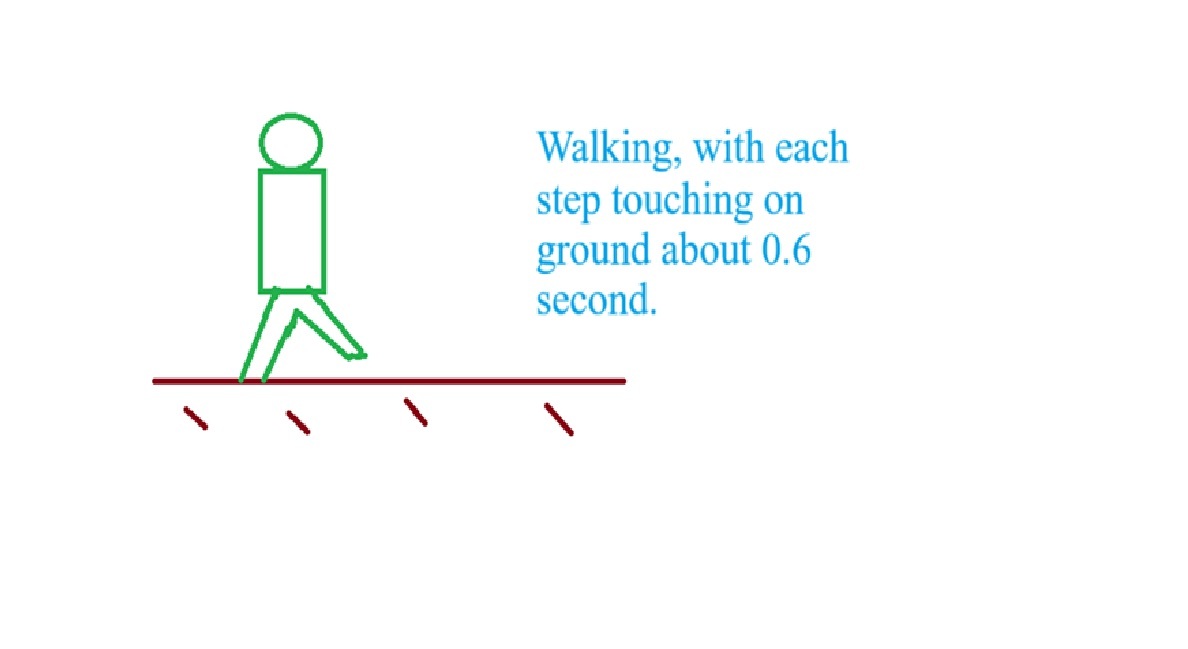
Wei Liu: People Over 30 Years Old Should Not Run Wei Liu, U. S. citizen, U. S. veteran, September 7, 2025 Many people feel pain from running, and some eventually rely on wheelchairs because running has damaged their knees. In the following, we use dynamics to compare walking and running to show how running harms the human knee. Dynamics describes motion with forces, as in Newton’s Second Law: Force = Mass × Acceleration (Wikipedia, 2025). Kinematics, in contrast, describes motion without forces, such as Velocity = Displacement ÷ Time (Wikipedia, 2025). When walking, human knees bend or flex about 60°; when running, knees bend about 120°, which is twice as much as when walking (Chris, 2021). When walking, humans are in full control of body weight, as shown in Figure 1 below (Graph by Author).
Let’s calculate how much time each foot touches the ground while walking. The average human step size is about 0.8 meters. It takes about 20 minutes to walk one mile, or 1,609 meters. Find the time each step remains in contact with the ground. Solution: Number of steps = Distance ÷ Step size = 1609 ÷ 0.8 = 2011 Next, let’s calculate how much time each foot touches the ground when running. Based on experience, only the first 30% of the contact time absorbs most of the momentum, or impulse. The average human step size while running is about 1.2 meters. It takes about 13 minutes to jog, slow running, for one mile or 1,609 meters. Find the time each step remains in contact with the ground when running. Solution: Number of steps = Distance ÷ Step size = 1609 ÷ 1.2 = 1341
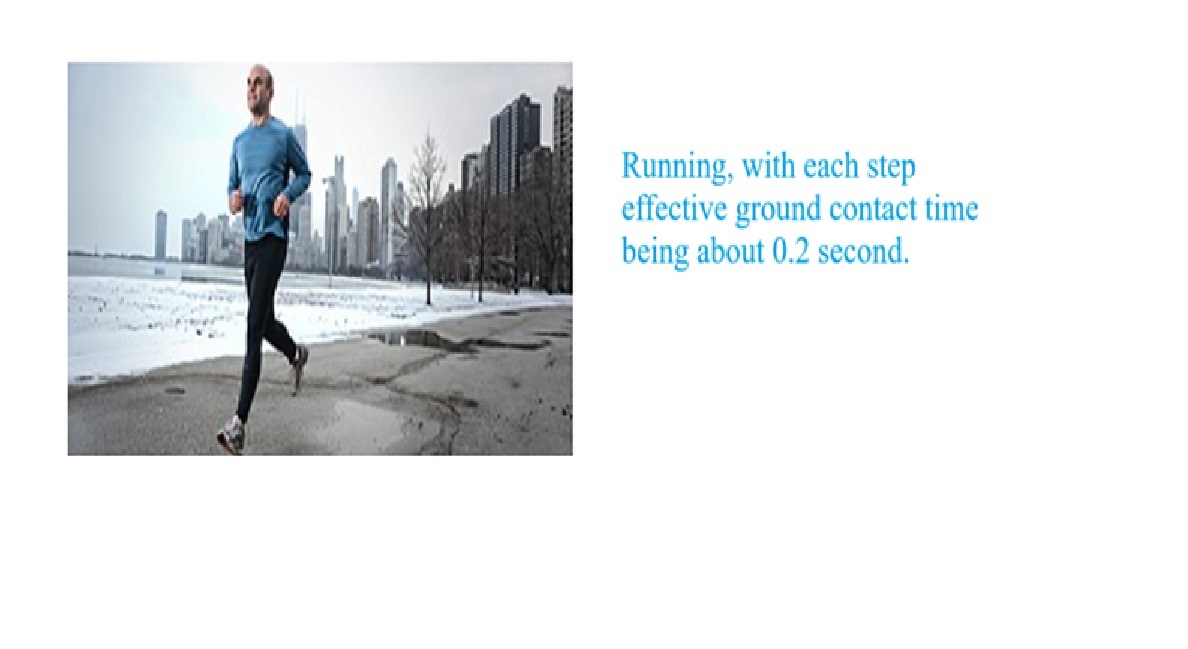
Running looks as in Figure 2 below (Wikimedia Commons, 2025).
The most important difference between walking and running is that when walking, a person has full control of body weight. For example, if someone sees water ahead while walking, they can hold a leg in the air and avoid stepping into it. When walking, foot height before contact is about 0.03 m. Because body weight is controlled, roughly half the body weight is borne on each landing. Suppose body mass is 65 kg and each step is in contact with the ground for 0.6 s. Find the momentum change and the average force on the knee when a step lands during walking.
Solution: Velocity final2 –Velocity initial2 = 2*g*Distance Velocity final2 –0 = 2*9.81*0.03 Velocity final = 0.767 m/s Momentum = Velocity final*0.5*Mass human (Walker, 2008). = 0.767*0.5*65 = 24.9 kg.m/s Impulse = Change of Momentum Force*Time = Momentum final –Momentum initial Force*0.6 = 24.9 –0 Force on ground = 41.5 Newton By Newton’s Third Law, Force on human knee = Force on ground = 41.5 Newton = 9.33 lbf
When running, the human body is momentarily in the air and does not have much control. Each step on the ground is essentially a free fall from a height of about 0.15 meters. Suppose the human body has a mass of about 65 kg. The effective contact time of each step is 0.2 seconds. Find the momentum and force on the human knee when each step lands on the ground while running. Solution: Velocity final2 –Velocity initial2 = 2*g*Distance Velocity final2 –0 = 2*9.81*0.15 Velocity final = 1.72 m/s Momentum = Velocity final*Mass human (Walker, 2008). = 1.72*65 = 112 kg.m/s Impulse = Change of Momentum Force*Time = Momentum final –Momentum initial Force*0.2 = 112 –0 Force on ground = 560 Newton By Newton’s Third Law, Force on human knee = Force on ground = 560 Newton = 126 lbf When walking, the knee experiences about 41.5 N or 9.33 pound-force per step. In contrast, running generates impacts an order of magnitude higher, reaching hundreds of pound-force per step. Although a healthy human knee can withstand about 560 N or 126 pounds-force in the short term, repeated exposure causes fatigue damage and gradual weakening of the joint. Walking is like driving with a seat belt: with longer contact time on the ground, the knees absorb much less force. Running is like driving without a seat belt: with much shorter ground contact time, the knees absorb about ten times more force compared with walking. From a biological perspective, adolescence ends around age 25. After that, human body produces fewer cells than it breaks down. This means that after about age 30, natural repair capacity declines. Combining these mechanical and biological factors, and based on a dynamics analysis of forces and impacts, it is reasonable to argue that people over 30 should avoid regular running, as the long-term impact forces can outpace the body’s ability to repair itself, ultimately undermining knee health.
References Chris Bailey Orthopedics. (2021). What range of motion should I be getting after my knee replacement? Walker, K. M. (2008). Applied Mechanics for Engineering Technology. Pearson. Wikimedia Commons. (2025). Running. https://commons.wikimedia.org/w/index.php?search=running&title=Special%3AMediaSearch&type=image Wikipedia. (2025). Dynamics. https://en.wikipedia.org/wiki/Dynamics_(mechanics) Wikipedia. (2025). Kinematics. https://en.wikipedia.org/wiki/Kinematics The end
|
|
 |
 |
| 实用资讯 | |
|
|
| 一周点击热帖 | 更多>> |
| 一周回复热帖 |
| 历史上的今天:回复热帖 |
| 2024: | 启之:《记忆》主编回应王友琴 | |
| 2023: | 中国政协 | |
| 2023: | 加萨屠城-人类有史以来最残忍的杀戮 | |
| 2022: | 彭羕之死 之 刘备这个老逼养的。。。 | |
| 2022: | 七絕 題照(1733)中华儿女显阳刚 | |
| 2021: | 内战真相,国军安能不败! | |
| 2021: | 错过科技暴发展时机,窝里斗罪大恶极! | |
| 2020: | 被印第安人诅咒的美国总统们(十三) | |
| 2020: | 《評:“美前高官強調發動“新冷戰”將 | |
