



| 美國家地理顛倒黑白惡意編造閆麗夢報告 |
| 送交者: Pascal 2020年09月20日12:46:30 於 [五 味 齋] 發送悄悄話 |
|
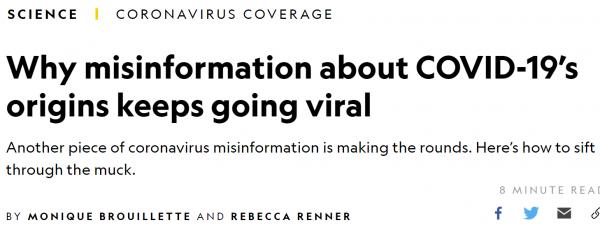
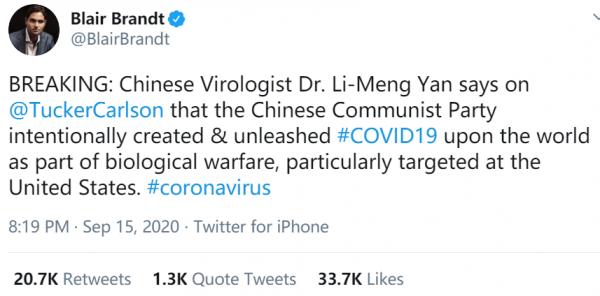
TWENTY YEARS AGO, data scientist Sinan Aral began to see the formation of a trend that now defines our social media era: how quickly untrue information spreads. He watched as false news ignited online discourse like a small spark that kindles into a massive blaze. Now the director of the MIT Initiative on the Digital Economy, Aral believes that a concept he calls the novelty hypothesis demonstrates this almost unstoppable viral contagion of false news. “Human attention is drawn to novelty, to things that are new and unexpected,” says Aral. “We gain in status when we share novel information because it looks like we're in the know, or that we have access to inside information.” Enter the Yan report. On September 14, an article was posted to Zenodo, an open-access site for sharing research papers, which claimed that genetic evidence showed that the SARS-CoV-2 coronavirus was made in a lab, rather than emerging through natural spillover from animals. The 26-page paper, led by Chinese virologist Li-Meng Yan, a postdoctoral researcher who left Hong Kong University, has not undergone peer review and asserts that this evidence of genetic engineering has been “censored” in the scientific journals. (National Geographic contacted Yan and the report’s three other authors for comment but received no reply.) A Twitter firestorm promptly erupted. Prominent virologists, such as Kristian Andersen from Scripps Research and Carl Bergstrom from University of Washington, took to the internet and called out the paper for being unscientific. Chief among their complaints was that the report ignored the vast body of published literature regarding what is known about how coronaviruses circulate in wild animal populations and the tendency to spill over into humans, including recent publications about the origins of SARS-CoV-2. The experts also pointed out that the report whipped up wild conspiracy theories and wrongly accused academic journals of plotting with conspirators by censoring important evidence. https://www.nationalgeographic.com/science/2020/09/coronavirus-origins-misinformation-yan-report-fact-check-cvd/
本文只是挑選了一些示例,排除了證據,並提出了一個荒謬的設想。 大衛·羅伯遜,格拉斯哥大學 七月,格拉斯哥大學的病毒基因組學研究員David Robertson在《自然醫學》上發表了一篇同行評審論文,該論文顯示了SARS-CoV-2的血統及其最著名的祖先名為RaTG13的病毒已經在蝙蝠中傳播。人口數十年。病毒學家認為,這種親戚與新型冠狀病毒有96%的同源性,可能在蝙蝠或人類宿主中繁殖和進化,然後在適應其當前形式並引起持續大流行之前約20年未被發現。 Yan的報告聲稱這個假設是有爭議的,並且RaTG13也是在實驗室設計的。但是,面對大量關於SARS-CoV-2及其祖先的遺傳證據的發表,這種說法就不成立了。更重要的是,該報告由法治協會(Rule of Law Society)資助,該協會是由前白宮首席戰略家史蒂夫·班農(Steve Bannon)創立的非營利組織,此後因欺詐被捕。這是許多病毒學家質疑其說法的準確性的另一個原因。 羅伯遜說:“實際上,它正在侵犯偽科學。” “本文只是挑選了幾個例子,排除了證據,並提出了一個荒謬的設想。” 《國家地理雜誌》與其他著名的病毒學家和錯誤信息研究人員聯繫,以更好地了解Yan報告的出處和出了錯。在此過程中,他們提供了克服冠狀病毒周圍錯誤信息的技巧。 我們對SARS-CoV-2的起源了解多少?冠狀病毒存在於自然界中,可以感染許多不同的生物。在蝙蝠,豬,貓和雪貂中發現了SARS樣冠狀病毒,僅舉幾例。根據SARS-CoV-2 的遺傳學,最廣泛認同的起源是其祖先在跳入人類之前先在野生動物中四處遊走(隨其所經歷的過程交換其遺傳特徵)。 儘管SARS-CoV-2的近親存在於蝙蝠中,但科學家尚未找到它的直接母體。該病毒可能已通過中間動物傳播,其中牽涉穿山甲,然後進化為能更好地感染人類。或以過去發生的例子為例,它可能直接使蝙蝠躍居為人類。在20年前中國爆發最初的SARS之後,研究人員開始調查當地洞穴中的野蝙蝠以及附近的人。一項2018年的研究發現,有翅哺乳動物中原始SARS病毒的遺傳近親以及人類鄰居中的特異性抗體(感染的殘留信號)。 尋找答案的精確事件導致溢出的流行是“大海撈針命題,說:” 伊恩·利普金,由哥倫比亞大學的流行病學家,誰共同撰寫的早期研究論文在自然醫學有關非典(SARS)的天然來源冠狀病毒2。Yan的報告稱,由於Lipkin在遏制2002-2003年SARS流行病方面的工作,他獲得了中國政府的獎項,因此該《自然醫學》報告存在“利益衝突” 。利普金說,這項指控是“荒謬的”,當被問及他對生物工程在SARS-CoV-2起源中的作用的看法時,他補充說:“沒有數據支持這一點。” 要發現冠狀病毒的天然來源,可能需要對中國的動物(包括蝙蝠和人類)進行大規模採樣,以追蹤新型冠狀病毒的進化。儘管尚未公布時間表,世界衛生組織正在準備一個小組在中國進行此類調查。
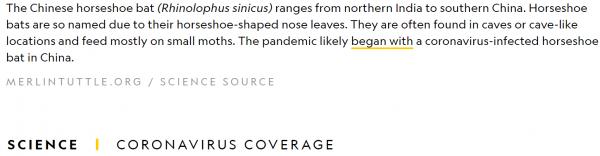
Yan報告怎麼說?Yan的報告試圖以不同的方式解決這個問題,首先是一個模糊的說法,即SARS-CoV-2不好感染蝙蝠,因此不可能來自蝙蝠。但是科學家指出,病毒正在不斷發展並在物種之間傳播。從蝙蝠到人類的最初溢出可能發生在幾十年前,這使病毒有足夠的時間為其刺突蛋白(它用於進入細胞的部分)提供通過自然選擇來感染人類的最佳條件。 Yan報告的另一個論點集中在刺突蛋白上存在“ 弗林蛋白酶切割位點 ”,這是一種關鍵的遺傳特徵,被認為可以增強病毒進入細胞的能力。該報告聲稱沒有其他冠狀病毒可發現此功能,因此必須進行設計。但是這種說法與發現相反:在野生種群中,在蝙蝠冠狀病毒上發現了類似的切割位點。 哥倫比亞大學病毒學家安吉拉·拉斯穆森(Angela Rasmussen)說:“如果我不得不解釋許多病毒具有切割位點的事實,我會大喊大叫。” 該報告還斷言,SARS-CoV-2“可疑”類似於中國軍事實驗室的科學家發現的兩種稱為ZC45和ZXC21的蝙蝠冠狀病毒。作者聲稱這些菌株可能已經用作克隆致命病毒的模板。但是其他科學家對此想法持反對態度。 看起來合理,因為他們使用了大量技術術語。但是實際上,他們所說的很多內容並沒有任何意義。 哥倫比亞大學的安吉拉·拉斯穆森(ANGELA RASMUSSEN) 首先,這兩個菌株相差多達3500個核苷酸鹼基對,這是遺傳密碼中使用的化學“字母”。因此,對於SARS-CoV-2生物工程來說,它們將是一個糟糕的起點。根據拉斯穆森和其他幾位病毒學家的說法,如果設計出一種病毒,而您必須替換其基因組的10%以上,那效率是低下的,即使不是不可能。羅伯遜說,這些毒株在中國軍事實驗室被發現的事實也“只是偶然的”。蝙蝠冠狀病毒在野蝙蝠中傳播,任何人都可能發現過。 該報告還指出,SARS-CoV-2具有“限制酶位點”,即可以被酶切割和操縱的遺傳序列。這些基因組特徵有時在克隆中使用,並且該報告聲稱它們的存在指示工程病毒。但是科學家指出,這些位點自然存在於從細菌到人類的所有類型的基因組中。 “這看起來是合法的,因為他們使用了大量的技術術語。但實際上,他們所說的很多內容都沒有任何意義。”拉斯穆森說。她補充說,使用限制酶的克隆類型已經過時了,因此不太可能用於製造病毒生物武器。從根本上講,製造工程病毒並不是一件容易的事。科學家們仍然只是試圖了解某些病毒比其他病毒更具感染力的分子和遺傳原因。例如,為病毒添加功能以使其更易於傳播,這稱為功能獲得研究。它在製造生物武器方面的潛力備受爭議,甚至在美國被禁止使用一段時間,限制了有關其工作方式的可用數據。 那麼嚴的報告是怎麼發表的呢?大流行的標誌是迅速湧入的研究和免費共享信息以加快發現的步伐。這種發布“預印本”(學術同行尚未審查過的報告)的做法具有其優勢。 羅伯遜說:“對科學界來說,它非常有用。”因為更多的研究人員可以快速分析可用數據。但是預印本也有陰暗面。錯誤信息是該流行病的另一個特徵,預印本在加劇未經證實的聲明的新聞報道中發揮了作用,包括病毒變異成更致命的形式,來自蛇或比真正的致命程度低。 他說:“當這是真正的新聞時,而當不是新聞時,很難弄清。”他指出,即使是經過同行評審的有關冠狀病毒的論文也都在急於出版的過程中出錯。誠實的錯誤和陰險的錯誤混合在一起,可能預示着在迅速發展的危機中出版業的發展趨勢。 Rasmussen說:“我不認為預印本系統會被武器那麼多,因為所有信息渠道都被用來散布錯誤信息:從社交媒體到操縱主流媒體再到預印本再到同行評審的期刊,無所不包。” 壞事傳千里儘管專家們的反對,燕報告和冠狀misformation的其他類似的例子,比如在Plandemic紀錄片,已經在社會化媒體,因為他們趁弱勢人的情緒得到了牽引力。這些感覺可以推動惡作劇的病毒傳播。 早在2018年,Aral及其麻省理工學院媒體實驗室的團隊通過分析Twitter的11年數據(約450萬條推文),將他們的新穎性假設進行了檢驗。他們的計算結果顯示出令人驚訝的相關性:“我們發現,虛假新聞在我們研究的所有類別的信息中都比真相傳播得更遠,更快,更深入,更廣泛。 正如阿拉爾(Aral)在他的新書《炒作機》(The Hype Machine)中所討論的那樣,發揮的不僅僅是新穎性。人們對社交媒體上的情感故事的反應方式是強烈且可預測的。Vitriol填滿了答覆,然後虛假新聞被轉發的可能性比真實情況高70%。 每當讀者決定分享新聞時,心理因素的複雜組合就會起作用,否則聰明的人可能會成為虛假信息周期的一部分。 一個因素是對知識的忽視:“ 范德比爾特大學心理學與人類發展助理教授麗莎·法齊奧(Lisa Fazio)表示:“當人們無法適當地將以前存儲的知識應用於當前情況時,” 。 人腦尋找簡單的選擇。讀者會偷工減料,經常在不深入了解故事本身之前與搶眼的頭條分享故事。即使社交媒體用戶確實閱讀了他們分享的內容,他們的理性思維也發現了其他放鬆的方法。 如果您聽到兩次,則比只聽過一次的可能性更大。 麗莎·法齊奧,范德比爾特大學 例如,人類容易產生確認偏差,這是一種將新信息解釋為對自己先入為主的觀念的驗證的方式。動機推理也打開了,大腦試圖將這些新的概念性拼圖拼合在一起,即使它們不合適也可以建立聯繫。 導致批判性思維扭曲的最有力因素是虛幻的真相效應,法齊奧在這種情況下將其定義為:“如果聽到兩次,則比只聽一次就更有可能認為這是真的。” 因此,盛行會加劇虛假新聞,然後回音室變成了自我永存的不信之旋風。 如果新聞涉及政治,那麼它還會帶來另一種病毒式傳播。“政治新聞比其他虛假新聞傳播得更快,”阿拉爾說。“我們可以推測,它是如此避雷針,因為它充滿了情感。” 對於Aral來說,Yan報告具有虛假新聞故事的所有屬性,這些故事原本是要傳播開來的。 “就這個特定的故事而言,我會說所有有關為什麼虛假新聞傳播的分析,” Aral解釋說。“令人震驚;這很色情 它與正在發生的政治辯論直接相關,但是冠狀病毒顯然在每個人的腦海中。試圖了解它的起源是一個大故事。” A Twitter firestorm promptly erupted. Prominent virologists, such as Kristian Andersen from Scripps Research and Carl Bergstrom from University of Washington, took to the internet and called out the paper for being unscientific. Chief among their complaints was that the report ignored the vast body of published literature regarding what is known about how coronaviruses circulate in wild animal populations and the tendency to spill over into humans, including recent publications about the origins of SARS-CoV-2. The experts also pointed out that the report whipped up wild conspiracy theories and wrongly accused academic journals of plotting with conspirators by censoring important evidence. This paper just cherry-picked a couple of examples, excluded evidence, and came up with a ridiculous scenario. UNIVERSITY OF GLASGOW In July, David Robertson, a viral genomics researcher at University of Glasgow, authored a peer-reviewed paper in Nature Medicine that showed the lineage behind SARS-CoV-2 and its closest known ancestor, a virus called RaTG13, have been circulating in bat populations for decades. Virologists think this relative, which is 96-percent identical to the novel coronavirus, probably propagated and evolved in bats or human hosts and then went undetected for about 20 years before adapting its current form and causing the ongoing pandemic. The Yan report claims this hypothesis is controversial, and that RaTG13 was also engineered in a lab. But that flies in the face of the overwhelming body of genetic evidence published about SARS-CoV-2 and its progenitors. What’s more, the report was funded by the Rule of Law Society, a nonprofit organization founded by former chief White House strategist Steve Bannon, who has since been arrested for fraud. That’s yet another reason ddmany virologists are questioning the veracity of its claims. “It’s encroaching on pseudoscience, really,” says Robertson. “This paper just cherry-picked a couple of examples, excluded evidence, and came up with a ridiculous scenario.” National Geographic reached out to other prominent virologists and misinformation researchers to better understand where the Yan report came from and what it got wrong. Along the way, they offered tips for overcoming misinformation surrounding the coronavirus. What do we know about SARS-CoV-2’s origins?Coronaviruses exist in nature and can infect many different creatures. SARS-like coronaviruses are found in bats, pigs, cats, and ferrets, to name a few. The most widely agreed upon origin of SARS-CoV-2, based on its genetics, is that its ancestors moved around in wild animals—swapping genetic features as they went along—before they jumped into humans. Scientists have yet to find the direct parent of SARS-CoV-2 in feral beasts, though its closest relatives exist in bats. The virus may have passed through an intermediate animal—pangolins have been implicated—and then evolved to become better at infecting humans. Or it may have made the jump directly from bats to humans, given past examples of such occurrences. After the original SARS outbreak in China 20 years ago, researchers began surveying wild bats in local caves and the people who live near them. A 2018 study found the genetic relatives of the original SARS virus in the winged mammals—as well as specific antibodies, a residual sign of infection, in their human neighbors. Finding answers to the precise events that led to a spillover pandemic is a “needle in a haystack proposition,” says Ian Lipkin, an epidemiologist from Columbia University, who co-authored an early research paper in Nature Medicine about the natural origins of SARS-CoV-2. The Yan report claims this Nature Medicine report had a “conflict of interest” due to Lipkin’s work in containing the 2002-2003 SARS epidemic, for which he received an award from the Chinese government. Lipkin says this accusation is “absurd,” and when asked for his view on the role of bioengineering in the origins of SARS-CoV-2, he adds: “There is no data to support this.” Uncovering the natural source of the coronavirus will likely require large-scale sampling of animals—including bat and human populations—in China to trace the evolution of the novel coronavirus. The World Health Organization is readying a team to conduct such an investigation in China, though a timetable has not been released. What does the Yan report say?The Yan report attempts to tackle this question in a different way, starting with the murky claim that SARS-CoV-2 is bad at infecting bats, therefore it could not have come from them. But scientists point out that viruses are constantly evolving and passing between species. The initial spillover from bats to humans could have happened decades ago, allowing the virus ample time for its spike protein, the part it uses to enter cells, to optimize through natural selection to infect humans. Another argument made by the Yan report centers on the presence of a “furin-cleavage site” on the spike protein, a critical genetic feature that is thought to enhance the virus’s ability to enter cells. The report claims this feature is found on no other coronavirus and therefore must be engineered. But this statement contradicts findings: similar cleavage sites are found on bat coronaviruses in wild populations. “I'm going to scream if I have to explain the fact that many viruses have cleavage sites,” says Angela Rasmussen, a virologist at Columbia University. The report also asserts that SARS-CoV-2 is “suspiciously” similar to two strains of bat coronaviruses, called ZC45 and ZXC21, that were discovered by scientists at military labs in China. The authors claim these strains could have been used as a template to clone a deadlier virus. But other scientists balk at this idea. It looks legitimate because they use a lot of technical jargon. But in reality, a lot of what they're saying doesn't really make any sense. COLUMBIA UNIVERSITY First, the two strains differ by as much as 3,500 nucleotide base pairs, the chemical “letters” used in genetic code. As such, they would be a poor starting point for bioengineering SARS-CoV-2. Engineering a virus in which you had to replace more than 10 percent of its genome is inefficient, if not impossible, according to Rasmussen and several other virologists. The fact that these strains were identified at a Chinese military lab is also “just circumstantial,” says Robertson. The bat coronaviruses were circulating in wild bats and could have been discovered by anyone. The report also argues that SARS-CoV-2 has “restriction-enzyme sites,” or genetic sequences that can be cut and manipulated by enzymes. These genomic features are sometimes used in cloning, and the report claims their presence is indicative of an engineered virus. But scientists point out these sites naturally occur in all types of genomes, from bacteria to humans. “It looks legitimate because they use a lot of technical jargon. But in reality, a lot of what they're saying doesn't really make any sense,” says Rasmussen. She adds that the type of cloning that uses restriction enzymes is very outdated, and so it is unlikely to be used to make a viral bioweapon. And on a basic level, making an engineered virus is not a trivial matter. Scientists are still just trying to understand the molecular and genetic reasons why some viruses are more infectious than others. Adding features to a virus to make it more transmissible, for example, is called gain-of-function research. It is highly controversial for its potential to make bioweapons and was even banned in the U.S. for a time, limiting the data available on how it works. So how was the Yan report published?A hallmark of the pandemic has been a rapid influx of research and free sharing of information to increase the pace of discovery. This practice of posting “preprints”—reports that haven’t been reviewed by academic peers—has its advantages. “For the scientific community [it] has been very useful,” says Robertson, since more researchers can quickly analyze the available data. But preprints have a dark side too. Misinformation has been another hallmark of the pandemic, and preprints have played a role in fueling news coverage of unproven claims, including the virus mutating into a more deadly form, coming from snakes, or being less deadly than it truly is. “It can be very hard to disentangle when that's real news and when it's not news,” he says, citing the fact that even some peer-reviewed papers on coronavirus have made errors in the rush to publish. This mixture of honest mistakes and insidious ones may just be indicative of a larger trend with publishing during a rapidly evolving crisis. “I don’t think the preprint system is being weaponized so much as all channels of information are being used to disseminate misinformation: everything from social media to manipulating the mainstream media to preprints to peer-reviewed journals,” says Rasmussen. Bad news travels fastDespite the objections of experts, the Yan report and other similar instances of coronavirus misformation, such as the Plandemic documentary, have gained traction on social media because they take advantage of vulnerable human emotions. Those feelings can drive the viral spread of hoaxes. Back in 2018, Aral and his team at the MIT Media Lab put their novelty hypothesis to the test by analyzing 11 years of data from Twitter, or about 4.5 million tweets. Their calculations showed a surprising correlation: “What we found was that false news traveled farther, faster, deeper, and more broadly than the truth in every category of information that we studied, sometimes by an order of magnitude,” Aral explains. More is at play than just novelty, as Aral discusses in his new book The Hype Machine. The way people react to emotional stories on social media is intense and predictable. Vitriol fills the replies, and false news then becomes 70 percent more likely to be retweeted than the truth. A complicated combination of psychological factors is at work whenever a reader decides to share news, and otherwise smart people can become part of the cycle of disinformation. One factor is knowledge neglect: “when people fail to retrieve and apply previously stored knowledge appropriately into a current situation,” according to Lisa Fazio, an assistant professor of psychology and human development at Vanderbilt University. The human brain seeks out easy options. Readers cut corners, often sharing stories with grabby headlines before looking deeper into the story itself. Even when social media users do read what they share, their rational mind finds other ways to slack off. If you hear something twice, you're more likely to think that it's true than if you've only heard it once. VANDERBILT UNIVERSITY For instance, humans are prone to confirmation bias, a way of interpreting new information as a validation of one’s preconceived notions. Motivated reasoning switches on too, and the brain tries to force these new conceptual puzzle pieces together, making connections even when they don’t fit. The most potent factor that warps critical thinking is the illusory truth effect, which Fazio defines with this scenario: “If you hear something twice, you're more likely to think that it's true than if you've only heard it once.” So prevalence turbocharges false news, and echo chambers then turn into self-perpetuating whirlwinds of misbelief. If the news involves politics, it gets yet another virality boost. “Political news travels faster than the rest of false news,” says Aral. “We can speculate that it’s such a lightning rod because it’s so emotionally charged.” And to Aral, the Yan report has every attribute of a false news story that was primed to go viral. “In terms of that specific story, I would say all of these analyses of why false news spreads apply,” Aral explains. “It’s shocking; it’s salacious. It's immediately relevant to political debates that are happening, but obviously coronavirus is on everyone’s mind. Trying to understand its origins is a big story.” https://www.nationalgeographic.com/science/2020/09/coronavirus-origins-misinformation-yan-report-fact-check-cvd/
英雄科學家閆麗夢博士團隊於美東時間9月14號早上十點,通過 社交媒體推特公開“中共病毒”報告。該報告由閆麗夢博士團隊 花費數月時間整合了大量醫學文獻和相關資料撰寫而成,報告共 二份。該報告曝光了肆虐全球的新冠病毒是中共軍方實驗室改造 而成的生物武器,此消息公開後全球震驚。巨大壓力下,迪斯尼 公司控制下的國家地理雜誌迅速發表論文回應“中共病毒”報告。 國家地理雜誌論文採取斷章取義手法,歪曲了閆博士報告的事實。 企圖誤導世界人民,以達到隱藏病毒真相的目的。本文梳理了國家 地理雜誌論文與閆博士“中共病毒”報告對比如下: 國家地理雜誌論文造假: 1、國家地理雜誌提到閆博士論文RaTG13通過實驗室改造而成; 2、國家地理雜誌提到閆博士論文中新冠病毒不能感染蝙蝠; 3、國家地理雜誌惡意編造閆博士論文,宣稱沒有發現其他冠狀 病毒具有弗林酶切位點; 4、國家地理雜誌提到許多病毒都有切割位點,因此沒有任何證據 表明新冠病毒中具有弗林酶切位點。 閆博士“中共病毒”報告打假: 1、閆博士論文並未提到RaTG13來自實驗室改造而成(康教授) 2、閆博士論文並未提到新冠病毒能否感染蝙蝠。報告明確新冠 病毒以舟山蝙蝠為模板,插入受體結合基序(RBM)和弗林酶切 位點後具備傳染人能力(冠博士) 3、閆博士論文中譜系Bβ冠狀病毒中沒有發現弗林酶切位點,並且 增加了一個數字來區分(胡博士) 4、閆博士論文中明確新冠病毒某些部位明顯改造,比如S蛋白修 改,並增加了弗林酶切位點(康教授) 在全世界調查病毒真相的大環境下,中共無法用正常科學論點回復 閆博士論文,證明其已經山窮水盡。中共企圖用其管理中國的流氓 手段挑戰世界文明,終究逃不過正義的審判。希望還在助紂為虐的 同胞放下屠刀,走向正義的一方,避免充當炮灰被中共吞噬。
~~~~~~~~~~~~~~~~~~~~~~~~~~~~~~
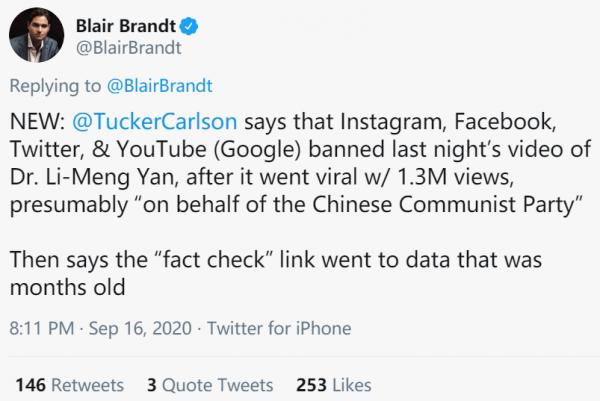
視頻鏈接: https://twitter.com/wenzhongbei/status/1307712885687070721
Pakistan and China have entered a secret three-year deal to expand potential bio-warfare capabilities, including running several research projects related to the deadly agent anthrax, a report by The Klaxon said, quoting multiple intelligence sources. Speaking to India Today from Sydney, the Editor-in-Chief of The Klaxon, Anthony Klan, said that the experiments were a serious 'concern' and exposed the nexus between China and the Pakistani military.
Anthony Klan, Editor-in-Chief of The Klaxon. (Photo: Twitter / @Anthony_Klan) Pakistan and China have entered a secret three-year deal to expand potential bio-warfare capabilities, including running several research projects related to the deadly agent anthrax, a report by The Klaxon said, quoting multiple intelligence sources. CHINA-PAK MILITARY NEXUS Speaking to India Today from Sydney, the Editor-in-Chief of The Klaxon, Anthony Klan, said that the experiments were a serious “concern” and exposed the nexus between China and the Pakistani military. “There have been experiments carried out since 2015 with five different high level pathogens. The studies are being conducted in Pakistan. A lot of the Wuhan Institute of Virology scientists are working on Pakistan soil with Pakistan’s defence agencies which raises very serious concerns among the intelligence agencies,” said Anthony. According to the report, China’s now infamous Wuhan Institute of Virology has signed the covert deal with Pakistan military’s Defence Science and Technology Organization (DESTO), to collaborate research in “emerging infectious diseases” and advance studies on the biological control of transmitted diseases. 據The Klaxon(新聞媒體)引征多家情報來源的報道指出,巴基斯坦與中共達成了一項為期三年的協議,旨在提升其潛在的生物戰能力,其中包含運行幾個致命炭疽製劑項目。The Klaxon的主編安東尼.克蘭在悉尼向《今日印度》報道,這些實驗令人深度擔憂同時也曝光了中共與巴基斯坦軍方之間的勾聯。 中巴之間的軍事勾聯 The Klaxon主編安東尼.克蘭在悉尼向《今日印度》報道,這些試驗令人深度擔憂同時也曝光了中共與巴基斯坦軍方之間的勾聯。“從2015年起有五種高致命性病菌的試驗已經在巴基斯坦開展。研究也同時在進行過程中。許多中共武漢病毒研究所的科學家正在巴基斯坦本土工作並與巴國防機構積極合作,引起情報界高度關注”,安東尼表示。 據報道,臭名昭著的中共武漢病毒研究所已與巴基斯坦軍方的國防科技組織(DESTO)簽署了一份秘密協議,擬協同開發合作“新發傳染病”及疾病傳輸的生物控制之先期研究。 巴基斯坦本土的試驗 儘管巴中雙方極力抵賴,仍有充足證據證實大量研究與巴基斯坦有密切相關。有證據表明試驗是在巴基斯坦本土實施的,安東尼表示,“令人產生興趣的是關於五種病原體的研究,武漢及中共資本被提及,在巴基斯坦當地的研究也被提及,例如來自數千的駱駝及其他動物和數千的人體血清。雖然具體實驗室地址沒有提到,但大致幾個區域有涉及”。 巴方政府出面表示關於生物安全3級實驗室沒有什麼可保密的,它確實在開展試驗。 巴基斯坦豚鼠(小白鼠)試驗 但報告的調查結果表示整個項目是中共政府與巴基斯坦軍方之間的秘密協議下進行的,對方要求他們在實施的具體地點和操作隱秘性應做些保密措施。 而實際上,報告表明巴基斯坦已經把這些試驗和測試付諸實踐。當問及當地新聞為何未作披露參與秘密實驗試驗者並不知情的話題時,安東尼說,“我認為大部分的試驗對象都是偏遠貧窮地區的牧民,取樣也都來自於他們,他們怎麼會明白他們參與的是什麼試驗,試驗的目的及結果是什麼。這是相當恐怖的一件事,太多的疑問”。 關於樣本量的使用,他表示,“大約2000-2500個試驗品用於一種研究試驗,有些約500個。總共,大約7000-8000人,4000-5000的動物參與了試驗,動物里大部分是駱駝,這些動物都是被馴化或餵養的”。 中共的資助 據報道,所有研究項目都是由屬於中共一帶一路政策下的中巴經濟走廊規劃(CPEC)的資助下所提供的資金。安東尼說,“這都是一帶一路政策下的中巴經濟走廊規劃所提供的資助,高達630億美金的資金投入…很難取得一個具體的明細於這些每個具體的研究,但都與一帶一路在巴基斯坦的投入相關。幾乎所有這些完全來自於中共的中科院病毒研究所的資金提供所資助,絕大部分都是一帶一路旗下的項目。” 生物武器 國際社會最大的擔憂是這項危險病原體的研究可以回溯到CCP病毒爆發前,而巴基斯坦並無相應設施來處理這種病毒,這樣一來,就使它變成了生物武器的滋生繁殖基地。這種對於沒有設備設施的巴基斯坦來說是非常危險的。 “如多方情報所擔憂的,你可以用技術來清除冠狀病毒,同時也可以很容易將其武器化。這發生在巴基斯坦境內,完全由中共所資助”, 安東尼表示。他補充說:“我們都知道這些病毒對於沒有具備處理能力的巴基斯坦實在是太危險了,BL3和BL4(生物安全3級和4級)是眾所周知的最高安全級別,然而,並未得知巴基斯坦有BL4級的相應設施。 情報表明,包括印度次大陸的國家都向The Klaxon表示他們深切擔憂這個涉及到中共在他們邊境測試生物試劑並試圖最小化“引發國際社會譴責的風險”的行為。一個高級情報消息表明國防科技組織(DESTO)也參與到隱秘生物武器計劃下的各種與炭疽相關的軍民兩用研究項目。 據報道,由武漢和巴基斯坦科學家所試驗的五項研究結果已經在科學雜誌上發表了論文,每種都涉及到檢測及動物傳染病的病原體的研究。研究包含了西尼羅河病毒(West Nile Virus),中東呼吸綜合徵冠狀病毒(Mers Coronavirus),克里米亞-剛果出血熱病毒(Crimean-Congo Hemorrhagic Fever Virus),血小板減少症病毒(Thrombocytopenia Syndrome Viru)以及基孔肯雅熱病毒( Chikungunya Virus)。 目前尚未發現任何有效的疫苗和治療手段來應對這些病毒,而這些都是目前世上最致命和傳染力最強的病毒。 據高度可靠情報透露,中共正通過武漢病毒研究所在巴基斯坦測試致命生物製劑並為巴方科學家提供廣泛的操控病毒及生物信息學的培訓, 以豐富和充實他們所謂潛在的攻擊性生物戰計劃。巴基斯坦有可能將此技術用於發動生物戰爭,或因貧乏的設施設備條件導致致命病毒的意外泄露。更進一步,有生物武器化和生物恐怖主義蔓延的危險,安東尼.克蘭說,“令人擔憂和恐懼的是,一旦這些病毒從實驗室意外泄露出來,將對社會造成多麼大的打擊, 未來這些病毒及技術的武器化帶來不可想象的後果。鑑於巴基斯坦不穩定的局面,這些擔憂都有可能變為現實。中巴雙方的否認,並不能抹去籠罩在世界人民頭上的生物武器化及生物病毒恐怖主義的陰霾。” 點評: 病毒及其研究本屬於醫學範疇,醫者救人之術,正常人的思維和邏輯是應該探究病毒來源,研發控制及殺滅病毒的方法和解決方案,而不是,邪惡到去把世界上最致命最有傳染性的病毒研究出對付人類。玩火者必自焚! ON PAK SOIL Despite fierce denial from Pakistan and China, there is enough proof according to the report that a lot of the research can be tied to Pakistan. Proving that the research is being carried out on Pakistani soil, Anthony said, “It is interesting to know that within these five studies, Wuhan is mentioned, Chinese funding is mentioned and studies on Pakistani soil are mentioned, for e.g. blood serum from thousands of camels and other animals and also thousands of humans. It does not mention specifically where the lab work is done, but mentions several areas.” “After we first reported this, the Pakistani government came out and said there is no secret about biosafety levels 3 labs which obviously confirmed that it was happening on Pakistani soil,” he added. PAKISTANI GUINEA PIGS The findings of the report also suggest that the entire project is being done between the Chinese government and the Pakistani military which allows them to keep the locations a secret and the operations “covert”. In fact, the report says that Pakistanis have been used for testing and have participated in the experiments. When asked how the news never got out and did the individuals who participated in such research in secret labs didn’t know, Anthony said, “I suspect not. I suspect that most of these studies have a rural sample size. Lot of them are herdsmen from remote areas. How much would they know of what they are involved in? These people wouldn’t know what the samples were for and what happens with the results of the studies that they have been privy to or have been involved in. It is a real scare. There are a lot of question marks.” On the sample size used, he said, “Around two thousand to two and a half thousand samples in each of the studies. Some of them were about five hundreds. Overall, there were about seven-eight thousand people and about 4,000-5,000 animals, predominantly camels or usually those that are domesticated or reared for consumption.” FUNDED BY CHINA All the research projects are being funded by China under the auspices of the China-Pakistan Economic Corridor (CPEC) which falls within China’s Belt and Road Initiative, according to the report. He said, “It is being done under the auspices of the economic corridor under the Belt and Road Initiative (BRI) and the US $63 billion fund... It is difficult to get an exact breakdown but the money for each of these studies, when we track, is tied to the BRI initiative in Pakistan. Almost all of it is funded by China so the Chinese Academy of Sciences and Institute of Virology. A lot of it is a part of the flagship BRI project.” BIOLOGICAL WEAPONS The biggest worry for the international community is the fact that this research with dangerous pathogens dates back to before the Covid-19 outbreak and the fact that Pakistan does not have the facilities for such viruses. Also, that this is a breeding ground for “biological weapons”. “You can use technology to wipe coronavirus etc., but it can also be weaponised very easily as has been the concern of many intelligence sources. This is happening on Pakistani soil, fully funded by China,” said Anthony Klan. He added, “It is happening in laboratories that are not necessarily equipped to handle some of the viruses. We know that some of the pathogens are too dangerous for the facilities that Pakistan operates. BL3 (biosafety levels 3 labs) and BL4 are known to be the most secure. There is no known BL4 facility in Pakistan.” Intelligence sources, including from the Indian subcontinent, have told The Klaxon they have serious concerns about the secret project, which involves China testing biological agents outside its borders in an apparent bid to minimize the “risk of drawing condemnation from the international community”. “DESTO has been engaged in various dual-use research projects related to anthrax under a covert biological weapons program,” one senior intelligence source said. According to another report by The Klaxon, the results of five studies conducted by Wuhan and Pakistani scientists have been published in scientific papers, each involving the “detection and characterisation” of “zoonotic pathogens”. The studies involve experiments and genome sequencing of the West Nile Virus; MERS-Coronavirus; Crimean-Congo Hemorrhagic Fever Virus; the Thrombocytopenia Syndrome Virus; and the Chikungunya Virus. There is no vaccine or cure for any of those pathogens, which are among some of the world’s deadliest and most contagious. As revealed by The Klaxon, highly credible intelligence sources believe China, via its Wuhan Institute of Virology, is testing lethal biological agents in Pakistan and providing “extensive training on manipulation of pathogens and bio-informatics” to Pakistani scientists, which could “enrich a potential offensive biological programme”. It was revealed China’s Wuhan Institute of Virology had allegedly recently signed a secret three-year deal with Pakistan military’s DESTO to collaborate research in “emerging infectious diseases” and the “biological control of transmitted diseases”. That Wuhan-Pakistan military tie-up had never been publicly announced or disclosed before, said the report. Key concerns are that Pakistan could use the technology in bio-warfare, or that deadly pathogens could accidentally escape from inadequately equipped facilities. Raising concerns regarding biological weaponisation and biological terrorism he said, “There are concerns and the most important threat is what if these viruses escape the laboratories accidentally, how much would the impact be. Secondly, is the weaponisation and potential future weaponisation of this technology. With the instability in Pakistan, the concern is real. China and Pakistan deny it, but the real danger is biological weaponisation and biological terrorism.” ALSO READ | Covid-19 virus made in Wuhan laboratory: Chinese virologist claims she has proofALSO READ | US issues sweeping new travel warning for China, Hong Kong
|































|
|
 |
 |
| 實用資訊 | |
|
|
| 一周點擊熱帖 | 更多>> |
| 一周回復熱帖 |
| 歷史上的今天:回復熱帖 |
| 2019: | 我看山很大,我看海很小——海 | |
| 2019: | 美元又降息啦?是否是川普的壓力? | |
| 2018: | 如果川普真的被定罪,川粉要表現好一點 | |
| 2018: | 提醒萬維編輯,加拿大美國法律禁止種族 | |
| 2017: | 文貴掌握的資料足以對中共整個最高領導 | |
| 2017: | 洞郎,正如尼羅河所言 | |
| 2016: | 溪谷閒人:美國公民社會道德基礎:信任 | |
| 2016: | 淡紫:晨跑 | |
| 2015: | 大衛:談談李家誠 | |
| 2015: | 我昨天看了一點有關量子的講座以及博客 | |
