



| 深山蘭:發現比鄰星有一顆行星 |
| 送交者: 深山蘭 2012年10月28日09:16:50 於 [五 味 齋] 發送悄悄話 |
|
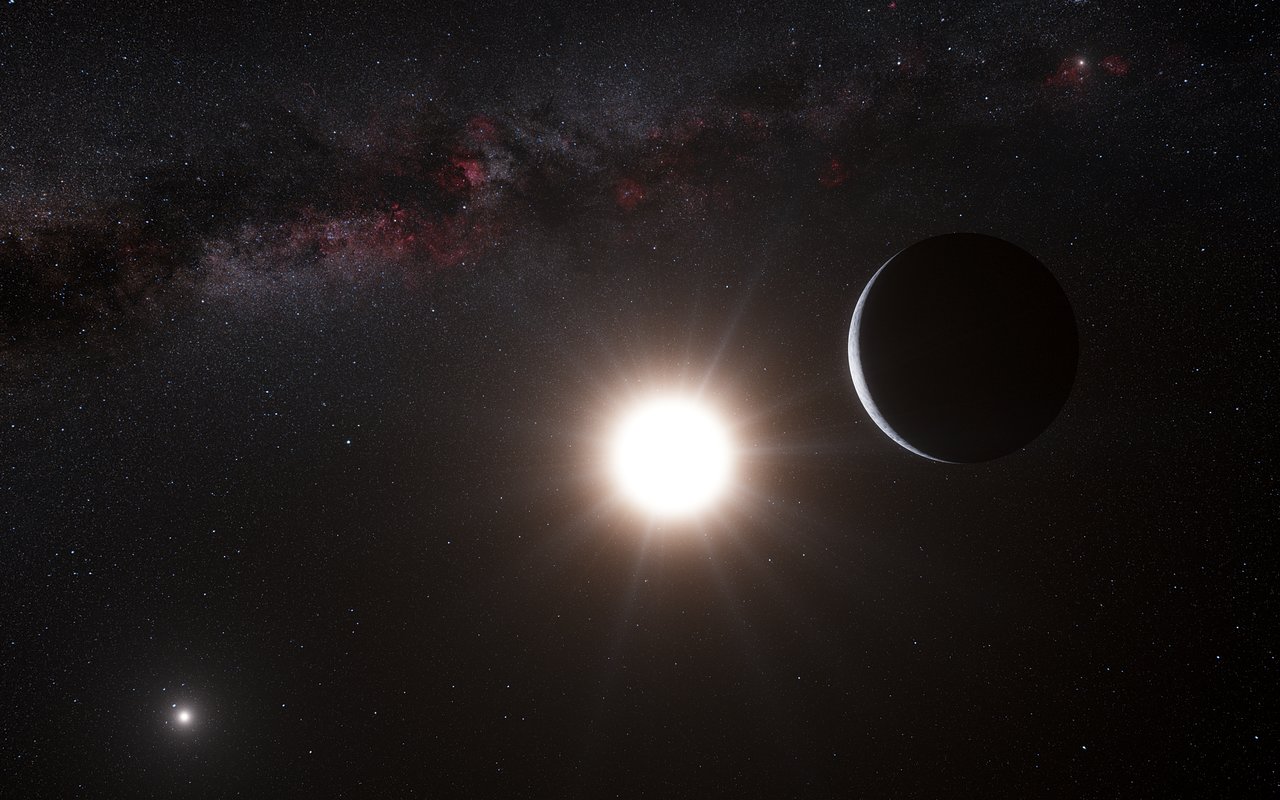
發現比鄰星有一顆行星 歐洲南天觀察台ESO(European Southern Observatory)最近用在智利的直徑3.6米的High Accuracy Radial velocity Planet Searcher (HARPS)發現太陽系最近的鄰居——比鄰星就是半人馬座α(Alpha Centauri)有一顆行星。 所謂HARPS就是利用有行星系統的恆星因行星對它的引力拖曳作用,使恆星在空中的軌道在作周期性“抖動”,測量該恆星的在我們和它的視線方向上的抖動速度,計算出行星的方法。很明顯,如果恆星的行星的運行軌道平面與我們和恆星間的視線垂直的話,該方法完全無效。 比鄰星居太陽系大約是4.3光年。在天文上,這是太陽系的隔壁鄰居。這顆(實際是一對恆星,見下)恆星在天空是第三亮的星星。古代中國把它叫做南門二,因為它是在星星天門的南面,把它想像成是大院的南門。 Alpha Centauri 可能是三星系統,Alpha Centauri A和Alpha Centauri B靠得較近,組成一個雙星系統。質量非常小的Alpha Centauri C在更遠的軌道上0.24光年和A、B星繞共同中心旋轉,也有可能它和A、B不是引力綁縛在一起,目前對地點不是很清楚。其中Alpha Centauri A是最亮的星。Alpha Centauri A比太陽略大;而Alpha Centauri B比太陽略小。 這是藝術家的想像圖。右上角的小星星是我們的太陽。左小角的是Alpha Centauri A星。 這次發現的行星是圍繞Alpha Centauri B 。Alpha Centauri B是和太陽相似的恆星。這顆行星按照目前行星的命名方式被命名為Alpha Centauri Bb。它在離宿主恆星僅6百萬公里的軌道上以3.2天的周期旋轉。它的質量比地球略大。它的軌道僅有地球居太陽距離的4%(就是它的軌道半徑僅有0.04AU),遠比太陽系最近的行星水星距太陽的距離五千七百九十萬公里的距離要近得多。由於該行星距離宿主恆星太近,儘管恆星的光度僅有太陽的一半,天文學家推測該行星的表面溫度可能高達1200攝氏度。那上面不太可能存在液體的水和生命。 歐洲的天文學家聲稱他們此次用該望遠鏡達到測量該恆星的徑向速度僅有51厘米每秒的數量級。兩三年前,這台望遠鏡的最高靈敏度還是1米每秒。他們已把此類技術達到了目前的極限。他們能測量出如此微小的速度,真是令人驚嘆。 他們稱此次發現是異乎尋常的。發現這樣一顆行星,推測也許還有其他的行星存在,也可能位於“可居住區”內。在理論上講,一顆恆星僅有一顆行星的情況應是少數,但由於目前測量技術水平的限制,只能發現靠近恆星的,相對質量較大的行星。 由於這個恆星是太陽的近鄰,觀察起來很方便,未來的歲月里,會有許多望遠鏡來觀察它。 當新一代的望遠鏡在未來幾年內投入使用後,也許會直接觀察到它的目前還未知的行星。更有可能會觀察到行星是否有大氣層。若有的話,其成分是什麼。如果它真的在可居住區內有大小合適的行星,那上面有生命存在,將不是什麼奇怪的事。 那將是激動人心的時刻。我們期待着。 下面是ESO網站介紹文章的主要部分。 Planet Found in Nearest Star System to EarthEuropean astronomers have discovered a planet with about the mass of the Earth orbiting a star in the Alpha Centauri system — the nearest to Earth. It is also the lightest exoplanet ever discovered around a star like the Sun. The planet was detected using the HARPS instrument on the 3.6-metre telescope at ESO’s La Silla Observatory in Chile. The results will appear online in the journal Nature on 17 October 2012. Alpha Centauri is one of the brightest stars in the southern skies and is the nearest stellar system to our Solar System — only 4.3 light-years away. It is actually a triple star — a system consisting of two stars similar to the Sun orbiting close to each other, designated Alpha Centauri A and B, and a more distant and faint red component known as Proxima Centauri [1]. Since the nineteenth century astronomers have speculated about planets orbiting these bodies, the closest possible abodes for life beyond the Solar System, but searches of increasing precision had revealed nothing. Until now. ESO will hold an online press conference offering journalists the opportunity to discuss the result and its impact with the scientists. To participate please read our media advisory. |
|
 |
 |
| 實用資訊 | |
|
|
| 一周點擊熱帖 | 更多>> |
| 一周回復熱帖 |
| 歷史上的今天:回復熱帖 |
| 2011: | Chinglish? | |
| 2011: | 李紋沒錢過奢侈生活了?居然嫁給了一個 | |
| 2010: | 作為五味打假英雄燉肘子,我認為必須對 | |
| 2010: | 在我的印象里,墩子不是黨員。在GELC培 | |
| 2009: | 問一個問題:你見到名人的時候激動嗎? | |
| 2009: | 真的佩服 翁帆,可以和那麼老的男人做 | |
| 2008: | 78 入學校三十周年慶祝大會的發言 | |
| 2008: | arendt: 我與離婚華男的故事 | |
| 2007: | 一個女人,讓40萬光棍瘋狂 | |
| 2007: | 玩兒去:針灸療法 | |
