



| 11.4.4.2 不相應行法 Noncorresponding Migration Laws |
| 送交者: 盧岩 2023年10月29日13:53:56 於 [茗香茶語] 發送悄悄話 |
|
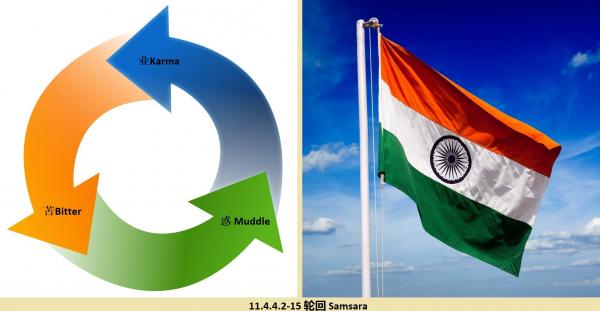
不相應行法從三義得名:一、此位諸法無緣慮作用,故不與心法、心所有法相應;二、此位諸法無質礙作用,故不與色法相應;三、此位諸法是生滅變異之法,也不與無為法相應。 Noncorresponding Migration Law is named from three meanings: first, laws in this faculty have no aggregative mind function, therefore do not correspond to Hearts (cf. section 11.4.5) and Heartland Laws (cf. section 11.4.4.1); second, the laws have not substantial obstructive effects, therefore do not correspond to Color Laws (cf. section 11.4.1); and third, the laws have birth, death, and mutation properties, therefore they are Migration Laws and do not correspond to None-as Laws (cf. section 11.6.4). 心不相應行法共有二十四位法:一、得,二、命根,三、眾同分,四、異生性,五、無想定,六、滅盡定,七、無想異熟,八 、名身,九、句身,十、文身,十一、生,十二、老,十三、住,十四、無常,十五、流轉,十六、定異,十七、相應,十八、勢速,十九、次第,二十、時,二十一、方,二十二、數,二十三、和合性,二十四、不和合性。 There are twenty-four Noncorresponding Migration Laws in total: I Gain, II Life Root, III Category, IV Mutant Nature, V Non-think Stillness; VI Extinctive Stillness, VII Non-think Mutation, VIII Name, IX Sentence, X Literature; XI Birth, XII Oldness, XIII Dwell, XIV Impermanence, XV Cycle; XVI Definitional Difference, XVII Correspondence, XVIII Potential Velocity, XIX Sequence, XX Time; XXI Direction, XXII Number, XXIII Combinability, XXIV Non-Combinability. 一)得,基於有情身心的諸法分位,設立三種獲得成就:種子成就,自在成就,現行成就。種子成就,某些法雖然不現行,但有潛在勢力的功能。自在成就,就是成為獨立自主的個體,所需能夠自給自足。現行成就,就是種子升起、現行,成為身口意的行為。 I) Gain, based on the juristic differential position in sentient body and mind, three types of attainment are established: seed achievement, self-sufficiency achievement, and performance achievement. Seed achievements are the functions of some laws that are not current but have potential powers. Self-sufficiency achievement means becoming an independent autonomous individual who is self-sufficient in his or her needs. Performance achievement is that seeds are arising presently as bodily orally and intentionally behaviors. 得的成就都涉及了種子的概念,什麼是種子?本章《生命之樹》講了五位百法,這百法就是一百粒種子,亦作百明法門。但是大乘佛教中有一粒成佛的種子,是大乘佛教的第一特徵,也就是能把凡人變成真人的種子,如圖11.4.4.2-15中從左向右第二小圖所示,即菩提心,亦作願渡(參見16.1節)。插圖1至22是墨西哥畫的,所以筆者我認為墨西哥沙門教相當於我們佛教的一乘,即金剛乘。 The Gain attained all involve the concept of seeds, what are seeds? The Tree of Life in this chapter talks about the five faculties of one hundred laws, which are one hundred seeds, also known as the Hundred Light Doors. But in Mahayana Buddhism there is a seed of Buddha, the first characteristic of Mahayana Buddhism, that is, the seed that can turn a mortal into a real human, as shown in the second small illustration from left to right in Fig. 11.4.4.2-15, namely, Bodhi-Heart, also known as Will Ark (see Section 16.1). Illustrations 1 through 22 were drawn by Mexico (i.e., Tlaloc), therefore the author I believe that Mexican Shamanism is equivalent to our Buddhist Oneness Vehicle, also known as Philosopher-Stone Vehicle.
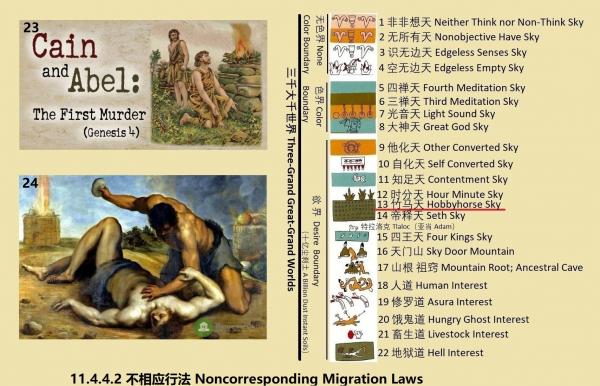
得的聖經用詞是凱恩(Cain),也是得義。插圖23和24是聖經里的寓言故事,亞當和夏娃的長子凱恩因為妒忌弟弟亞伯(Abel)深受上帝寵愛而殺了他。上帝為此懲罰了凱恩,把他從 “心地法” 流放到了本小節的 “不相應行法” ,還在他的身上做了記號。 The Biblical word for "gain" is Cain, which also means gain. Illustrations 23 and 24 are a Biblical fable in which Cain, the firstborn son of Adam and Eve, killed his brother Abel because he was jealous of his brother's great favor with God. God punished Cain for this by banishing him from the front “Heartland Laws" to the " Noncorresponding Migration Laws" in this subsection and marked his body. 亞伯是什麼?亞伯的字面意思是自負、能,是人的內在隨念自我;華人文化中稱作福,亦作大力神,福在佛教中稱作儒童(梵語摩納婆),印度教中作婆羅門,基督教、伊斯蘭教、和古埃及文化中稱作亞伯,日耳曼文化中作馬格尼,墨西哥文化稱為靈龍。 What is Abel? The literal meaning of Abel is conceit, able, is the internal along-thoughts ego of a person; in Chinese culture it is Fortune, also known as Great Strength God, Great God Sky (Fig. 11.4.4.2-8) in Buddhism, Brahman in Hinduism, Abel in Christianity, Islam, and Ancient Egyptian cultures, Magni in Germanic cultures, and Quetzalcoatl in Mexican cultures. 那亞伯被凱恩殺了,表明了什麼?表達了亞伯是可以被殺死的,也就是人不是生來就有自內我(亞伯)這位法的;這是一個根本的哲學問題。比如十八世紀德國的哲學家黑格爾和馬克思就曾經辯論過人思維機制里的那個小我(即亞伯)存不存在!結果怎麼樣?黑格爾錯了,馬克思說對了:亞伯不存在!這個問題在佛教中是怎麼看的?中國佛教認為這個人內部的隨念自我是可以被殺死的,但它的害處不大,修習者沒必要殺死它。墨西哥沙門教認為殺死靈龍是犯罪。 So, what does the fable of Abel being killed by Cain indicate? It shows that Abel can be killed, i.e., that man is not born with this law of internal along-thoughts ego (Abel); this is a fundamental philosophical issue. For example, the eighteenth-century German philosophers Hegel and Karl Marx once debated the existence or non-existence of the internal along-thoughts ego (i.e., Abel) in the mind mechanism! What was the result? Hegel was wrong and Karl Marx was right: Abel does not exist! How is this question viewed in Buddhism? Chinese Buddhism believe this internal along-thoughts ego can be killed, but it is not so harmful that there is no need for the practitioner to kill it. And it is a crime to kill Quetzalcoatl in Mexican Shamanism. 為什麼上帝不喜歡凱恩?因為無意識(即神識)只與舍受相應,與得、取、集的性質相違。 Why does God not like Cain? Because the unconscious (i.e., God-sense) corresponds only to the renunciative acceptance, which is contrary to the nature of gain, fetch, and aggregate, etc. 上帝在凱恩的身上做了什麼記號?凱恩和亞伯都是法,不是人,所以作者我認為那記號做在了亞當的身上,就是亞當的肉眼通(參見第三章)。 What mark did God put on Cain? Both Cain and Abel are laws, not men, so the author I think that mark was made on Adam, Flesh Eye Through (cf. chapter 3). 二)命根,就是有情的壽命;依先業所行,無意識的異熟果恆相續,維持有情身心性命。 II) Life Root is the lifespan of a sentient being; according to behaviors of preceding karma, unconscious variant ripens fruits succeedingly to sustain the physical and mental life. 三)眾同分,依有情身心相似分位差別,建立同分,即類別,從而形成了眾同分。例如,基於眾生對根本十戒的違順,約心、煩惱、和境而辨別分類,遂有六趣:地獄趣、畜生趣、惡鬼趣、修羅趣、人趣、和天趣(插圖11.4.4.2-1至22;參見第13章)。 III) Category, based on the differences and similarities of sentient being’s bodily and mentally differentials, same differentials are established, hence categories. For example, based on sentient beings' transgressions of the Ten Fundamental Precepts, they are categorized according to their hearts, annoyances, and environments, and there are six interests: hell-interest, livestock interest, hungry-ghost interest, asura-interest, human-interest, and sky-interest (Illustration 11.4.4.2-1 to 22; Cf. Chapter 13). 四)異生性 IV) Mutant Nature異生性是凡夫性的異名,依其種子煩惱和所知而建立。又煩惱和所知妨礙異生出離其本性,所以亦被稱作煩惱障和所知障。 Mutant nature is a synonym for mortal nature, is established by its seeds of annoyances and knows. Annoyances and knows hinder mortals from departing from theirs own natures, so the two are also called the annoyance hindrance and know hindrance. 煩惱障即是思煩惱,亦作思惑,如貪、嗔、痴、慢、疑、身見、邊見、邪見、見取、戒取等。所知障即是見煩惱,亦作見惑,如身見、邊見、邪見、見取、戒取、貪、嗔、痴、慢、疑等。 Annoyance hindrances are mean annoyances, also known as mean muddles, such as greed, irritation, ignorance, arrogance, suspicion, Seth view, edge view, heresy, view fetch, precept fetch, and so on. Know hindrances are view annoyances, also known as view muddles, such as Seth view, edge view, heresy, view fetch, precept fetch, greed, irritation, ignorance, arrogance, suspicion, etc. 煩惱障和所知障相互依存,成對兒存在,煩惱由所知而被認知,所知由煩惱而有感,所以此二者具有相同的名和數。煩惱障即是愚痴,能障清淨,障涅槃。所知障似智非智,能障智,障覺悟,所以也被稱作智障。 Annoyance and know hindrances are interdependent and pairs; Annoyance is recognized by know and know is felt by annoyance, so the two have the same numbers and names. Annoyance hindrances are foolishness, ignorance, which can hinder quietness and nirvana. The know hindrance is like intelligence but not intelligence, and can obstruct intelligence and enlightenment, so it is also called the intelligence hindrance. 五)無想定,亦名無心定、長壽天,是佛教中的人生八難之一。謂有異生入於禪定,背想作意,持續強行鎮壓前意識(亦作夏娃識),日復一日,月復有年。夏娃變得越來越細,終於被折斷了;此位禪定修習者就變成了植物人,住於長壽天中等待此無想定異熟果報被消耗盡了,再墮落於人間。定是身心與環境相應而動的一心狀態;他都沒有心,怎麼還被稱作定呢?因為想滅為首,身心安和,故被稱為無想定。 V) Non-think Stillness, also known as Heartless Stillness and Longevity Sky, is one of the Eight Difficulties of Life in Buddhism. Saying that a mutant who enters meditation and, with the intention to terminate thinks, continues to forcefully suppress the preconsciousness (aka Eve-sense), day after day, month after year. Eve becomes thinner and thinner and is eventually snapped off; this meditational practitioner becomes a plant man or woman and dwells in the eternal Longevity Sky waiting for the fruit of this Non-think Stillness to be consumed and then falls back to mundane world. Stillness is one-heart state in which the subjective and objective change mutually, the person is even not a heart, how is that called a stillness? Because to terminate thinks is the first thing to go, and the body and mind are at peace, so it is called Non-think Stillness. 六)滅盡定,亦作滅彼定,是所有的客觀對象都被消滅了的狀態,即是插圖11.4.4.2-2的無所有天。涅槃是無為法,他或她這樣努力地消除客觀對象,是有為法,怎麼也到了涅盤了呢?她或他在努力作為的過程中,肯定會經歷許多挫折和失敗,也會有許多灰心喪氣的時候,那些灰心喪氣與無意識的舍受相應,因此也會增加涅槃出現的概率。 VI) Extinctive End Stillness, also known as Terminating Objective Stillness, is the state in which all objectives are terminated, is nirvana (Fig. 11.4.4.2-2 No Objective Sky). Nirvana is an None-as Law (aka Un-striving Law), so how can he or she also reach Nirvana when he or she makes such an effort to eliminate the objective objects, which is a Have-as Law (aka Striving Law)? In her or his efforts to act, she or he will surely experience many setbacks and failures, and there will be many moments of discouragement and losing heart, those frustrations or losing hearts correspond to unconscious’ renunciative acceptance, therefore increase the probability of the appearance of nirvana. 七)無想異熟,也作無想報,禪定中,修習者可能有短暫的無想階段出現。古德解釋,人常有消極或自殺的想法,因此種下了無想的種子。當種子被薰習成熟,就發起現行了。無想異熟是正常的現象,無害。 VII) Non-think Mutant Mature, also known as Non-think Retribution, is a brief phase of no-thought that may occur to the practitioner during meditation. Ancient Virtues explain that people often have negative or suicidal thoughts, thus planting the seed of thoughtlessness. When the seed is ripened by fumigation, it initiates the present. The ripening of thoughtlessness is a normal phenomenon and is harmless. 八)名體,詮諸法的自性,如眼、耳、鼻、舌、身等。 VIII) Name Body, explains the self-natures of laws, such as the eyes, ears, nose, tongue, and body, etc. 九)句體,詮諸法的差別,如說,“無意識是前意識、意識、和身識等的總根;前意識隨着注意於眼識或耳識等識時,轉動成為那個識的工作平台,並不斷地自我更新。” IX) Sentence Body, explains the differences of laws, such as the saying, "The unconscious is the total root of the pre-consciousness, intent-sense, and body-sense, etc.; and the pre-consciousness, as it pays attention to a sense such as the eye-sense or the ear-sense, rotates to become the work-platform of that sense, and continually renews itself." 十)文體,是字,為名句的所依,如說佛教的憲章為:“諸行無常。諸法無我。涅槃寂靜。此三法案為佛所封印,不得更改。” X) Literal Body, is words, is the basis for names and sentences, such as Buddhist charter: “Migrations are impermanent. Laws have non-I. Nirvana is silent. The three juristic cases are sealed by Buddha, may not be altered." 十一)生,在眾同分的所有諸行中,從無到有是生。 XI) Birth, is from none to have among migrations in categories. 十二)老,在諸行相續的過程中,變壞為老。 XII) Oldness, is deteriorations during the successions of migrations. 十三)住,在諸行相續的過程中,隨轉為住 XIII Dwell, is going along the course of the successions of migrations. 十四)無常,在諸行相續的過程中,謝滅為性。 XIV) Impermanence, is fades and extinctions during the successions of migrations. 十五)流轉 XV) Cycle六趣有情遷流於三界九地之中,不得休息和出離,其因果不出十二有枝:無明、行、識、名色、六處、觸、受、愛、取、有、生、老死。 Sentient beings of the Six Interests drift among the three boundaries nine lands, their causes and fruits are among the twelve have branches: Non-Light (Ignorance), Migration, Sense, Name-Color, Six Places, Touch, Acceptance, Love, Fetch, Have, Birth, Old Death. 無明義為昏暗、想知道得清楚些,即是無知,從而引發了行枝的運動。此運動,或說由行枝引起的不同,就是識,就是識枝。雖說行枝和識枝同時而有,依據因果,把此二分了先後。就這樣,無明枝和行枝引發了後面五枝業果。 Non-Light means dim, and wanting to know, is Ignorance, so that causes the Migration Branch to move. Differences caused by Migration Branch are Senses, are Sense Branch. Although the Migration Branch and Sense Branch come into existence at the same time, based on cause and effect, we divide these two into successive stages. In this way, the Non-light Branch and Migration Branch trigger the next five fruits branches. 識、名色、六處、觸、和受,五枝被稱作五果,義為它們過去業習氣果的現行。識枝把信息傳播到了名色枝。名即四無色蘊, 即受蘊、想蘊、行蘊、和識蘊,色即色蘊;名和色合在一起就是心,但此時心並不明了,只能說是識正把信息向有情身心擴散。明是明白、內明的光明。當六處收到信息後,由於先業的作用,心開始形成,所以觸枝顯現了。觸(參見11.4.4.1.1節)是遍行心所有法的觸枝,有類似於心的功能,可以為心的形成提供動力。當六處明了,受枝就出現了。受枝遇痛則死;若遇到可愛果,受會招引位於三界九地的同類法來攝取可愛果。受枝出現之後,心就變得明了了。一而再,再而三,就引發了後面的孕育三枝。 The five branches of Sense, Name Color, Six Places, Touch, and Acceptance are called Five Fruits, meaning the fruitful performances of their past karmic habits. The Sense branch transmits information to the Name Color Branch. Names are the four colorless nodes, i.e., acceptance node, think node, migration node, and sense node; Color is color node. Name and Color, together are the heart, the flesh body and mind, but at this point, the heart is not illuminated yet; it can only be said that the Senses are spreading the information to the heart, i.e., the flesh body and mind. Illumination is saying of internal light, light of enlightenment. After Six Places (Cf. section 11.3) receive the information, due to karma, heart starts to form, therefore a similar heart, Touch Branch arises. Touch is an Omnipresent Heartland Laws (Cf. section 11.4.4.1.1), can provides heart power during heart formation. After the Six Places are illuminated, the Acceptance Branch appears. When Acceptance Branch encounters pain, it dies; if it encounters lovely fruits, can summon similar laws located in the three boundaries and nine lands. After the emergence of the Acceptance Branch, the heart is fully illuminated. Repeatedly and again, it triggers the later three gestation branches. 愛、取、有三枝可以孕育有情,所以被古人稱作能生枝。可愛果是異熟果(參見11.6.1節),稀少,像是農業產品,數量有限;而受枝的享受者是等流果。等流果易招,異熟果難求,進而愛生。愛是肥水,能孕育萬物,會導致取枝的出現。一而再,再而三,有枝就出現了。什麼是有?記憶有,習氣有就是有。有枝會導致後面的生枝和老死枝。 The three branches of Love, Fetch, and Have can give birth to interests, and so they were called three gestation branches by Ancient Virtues. Lovable fruits are mutant fruits (cf. Section 11.6.1), scarce, like agricultural products, limited in quantities; and the enjoyers of the Acceptance Branch are equal-stream fruits. Equal-stream fruits are easy to summon, but mutant fruits are hard to get, therefore Love Branch emerges. Love is fertile water, can brew anything, therefore Fetch Branch emerges. More, and again, Have Branch is formed. What is the have? Having memory and having habit are haves. Have Branch can induce later branches of Birth and Old Death. 生支和老死枝是被前文的能生支引發的。從無到有為生。衰敗為老。滅絕為死。死不一定出現,所以古人用老死來建立此枝。前習氣已被孕育了,這出生就是必然的了,隨後就有了愁、嘆、苦、憂、惱、老死。 The Birth Branch and Old Death Branch are induced by the preceding gestation branches. From nothing to something is birth. Decay or deterioration is old. Extinction is death. Death does not necessarily arise, so the ancients used old-ness and death together to establish this branch. The former habit having been conceived, this Birth is inevitable, followed by sorrow, sighing, bitterness, worry, anguish, and old death. 十二有支亦惑業苦三輪來攝取。惑攝無明支、愛支和取支。業攝行支和有支。苦攝識、名色、六處、觸、受、生和老死。名色、六處、觸、受和識即是有情身心;生死是有情的煩惱。因此苦輪所攝就是苦海中的眾生。這樣,這十二有支的因果循環,就變成了:眾生受苦起惑,因惑起行造業,業又生苦;如是惑業苦循環無盡。 The twelve have branches can also be assimilated by a Wheel composed of Muddle Karma and Bitter. Muddle assimilates Non-light, Love, and Fetch. Karma assimilates Migration and Have. Bitter assimilates Sense, Name Color, Six Places, Touch, Acceptance, Birth, and Old Death. Name Color, Six Places, Touch, Acceptance, and Sense are sentient beings' bodies and minds. Birth and Death are sentient beings' annoyances. Thus, the Bitter takes in all sentient beings in the bitter sea. In this way, the cycle of cause and fruit of these twelve have branches becomes: sentient beings receive bitter to create muddles, and because of muddles they create karma, and karma gives rise to bitter; so, the Wheel of Muddle Karma and Bitter is rolling itself ceaselessly.
此十二有枝,古人稱作十二緣起,亦作流轉真如,是佛教中的七真如之一。契經中是這樣描述的:無明望行、行望識、識望名色、名色望六處、六處望觸、觸望受、受望愛、愛望取、取望有、有望生、生望老死,起愁嘆苦憂惱,成大苦具。 These twelve have branches, which the Sanskrit word is pratītya-samutpāda-aṅga, also known as Samsara True-Suchness, is one of the seven kinds of true suchness in Buddhism. The harmonious sutra describes it like this: Non-Light watches Migration, Migration watches Sense, Sense watches Name-Color, Name-Color watches Six Places, Six Places watch Touch, Touch watches Acceptance, Acceptance watches Love, Love watches Fetch, Fetch watches Have, have watches Birth, Birth watches Old Death, arise a great worry, sighing, bitter, gloomy, an annoying aggregate is formed. 十六)定異,設立於因果的種種差別相上, 即趣類的特質,是分類的依據。 XVI) Definitional Differences, are established on the various phenomena of cause and fruit, i.e., the traits of interest classes, and are the basis for categorization. 十七)相應,於因果法相關的意義上設立,相應即相順,如前文心所有法於心相應,心生起時,心所有法隨心而起。不相應,即彼此互不影響。 XVII Correspondence, is established in the sense of the correlation of cause-and-fruit laws. Correspondence means conformity, such as in the previous section, heartland laws correspond to the heart, and when the heart arises, heartland laws arise with the heart. Not corresponding, i.e., not affecting each other. 十八)勢速,建立於因果法中的動能勢能轉化現象,用來表現法的性質,如說貪、嗔、痴有強大的勢能,可以孕化其它法的速力。 XVIII) Potential Velocity, is established on the phenomena of kinetic-potential transformation in the law of cause and effect, to be used to express the natures of laws, for example, it is said that greed, irritation, and ignorance have strong potential energies to breed the speedy force of other laws. 十九)次第,建立於因果法中的相續發生的現象。 XIX) Sequence, is established on phenomena occurring successively in the law of reason and fruit.
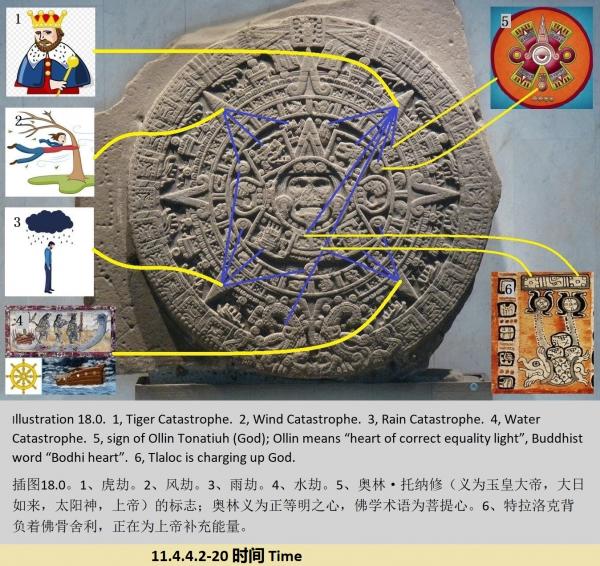
二十)時, 於因果相續流轉,時間被設立了。由有因果相續故,若此因果已生已滅,立過去時;若未生,立未來時;若已生未滅,立現在時。又世間義為兩時之間,基於流轉真如和塵世的形成和衰敗,劫歷被建立了。一世界有四中劫:成劫、住劫、壞劫、空劫。每個中劫包括二十小劫。一增一減,或說一個流轉(即輪迴)為一小劫。插圖11.4.4.2-20是本書第18章的主題圖,中間是墨西哥的劫歷石。 XX) Time, in the successive flow of cause and effect, time is set up. By the fact that there is a succession of cause and effect, if this cause and fruit has been born and extinguished, the past time is established; if it has not been born, the future time is established; if it has been born and has not been extinguished, the present time is established. Also, the Mundane-World is defined as between two times and based on the Cycle True-Suchness and the formation and decay of the earthly world, the Catastrophe Calendar is established. There are Four Middle Catastrophes for a Mundane-World, namely, Establishment, Dwell, Damage, and Empty. Each Middle Catastrophe consists of twenty Small Catastrophes. One increase and one decrease, or one Cycle (Samsara) is one Small Catastrophe. Illustration 11.4.4.2-20 is the subject map for Chapter 18 of the book, with the Mexican Catastrophic Calendar Stone in the center. 二十一)方,依於形質前後左右而建立,故有東西南北四維上下差別。依此方向,方隅、地方被建立了。一般佛教談的都是思想意識內世界,即五蘊世間,如聖經的第一章說的就是五蘊世間,述說了一個完整心理機制學寓言。佛教稱唯物主義世界為器世間。 XXI) Direction, according to the front and back and the right and left of substantial forms, so there are four dimensions of east, west, south, north, and up and down differences. Based on these directions, places and localities are established. In general, Buddhism talks about the mental inner world, which is called Five Nodes Worlds, such as the first chapter of the Bible, which is about the world of the five nodes, and describes a complete mind mechanical fable. Buddhism calls the material world as Vessel World. 二十二)數,依於色心諸行眾多品類的一一差別而建立。 XXII) Number, is established according to the one-to-one differences of the many categories among color-heart’s migrations. 二十三)和合,於有因果共相的眾緣集會,設立為和合。如識法,因果相續,必借眾緣和會:根不壞,境界現前,能生識的作意正起;就說集起的眾成員有和合性。 XXIII) Combinability, is established on the aggregative phenomena of cause and effect, if the aggregation is fruitful, we say that those causing factors are combinable. For example, in the case of the sense laws, the succession of cause and fruit must be from aggregation of crowds factors, such as roots are not damaged, environments are presenting at front, senses producer Attention is arising; we say that all elements in the aggregate are combinable. 二十四)不和合,與和合性相對立,眾緣集會時不產生預期的因果現象,例如美國人向以色列提供武器並高唱自衛,以色列人的戰爭變得更強烈了;我們就說提供武器,以色列人,和戰爭,此三沒有停火的和合性。 XXIV) Non-Combinability, as opposed to Combinability, does not yield the expected causal phenomena when the congregation is gathered, e.g., when the Americans provide the Israelis with weapons and sing about self-defense loudly, and the Israelis' wars become more intense; we say that there is no cease-fire Combinability between the provision of weapons, the Israelis, and the wars. ↪️返回第11章《生命之樹》的目錄 Return to Content of Chapter 11🎄Tree of Life |
|
 | ||
|


 |
| 實用資訊 | |
|
|
| 一周點擊熱帖 | 更多>> |
| 一周回復熱帖 |
| 歷史上的今天:回復熱帖 |
| 2022: | 【老歌新唱】學習李強好榜樣(生茂1963 | |
| 2022: | 秋·2022 | |
| 2021: | 白瑪程列智慧海:漢族人可能真的不會考 | |
| 2021: | 習主席是不可能200斤走過百米的,可馬 | |
| 2020: | 白菜在大雜又有新作了。白菜每篇都寫得 | |
| 2020: | 如果你想風流 | |
| 2019: | 剛才去看了一下西依貼的視頻,姑娘確實 | |
| 2019: | 看了西依兄貼的李子柒視頻很感動,了解 | |
| 2018: | 哈哈,五味DSB甲醛中毒還不知道 | |
| 2018: | 巫弟,你媽生病怪罪於中共國的產品,對 | |
